


NO.86



- Last updated:2026-04-29
- Clicks on the following title, but browses this article fast
- Policies & Regulations Legislative Yuan Passes Third Reading of Delivery Workers' Rights Protection and Delivery Platform Management Act Ministry of Labor Releases "Guidelines for Enterprises on the Prevention of Forced Labor", Helping Enterprises Align with International Standards for Fair Recruitment Ministry of Labor Releases Reference Guidelines for Negotiation between Employers and Employees on Postponing Retirement Age and Reemployment after Retirement Employers, Avoid These Pitfalls! The Ministry of Labor Highlights Three Key Points of the New Flexible Parental Leave System — Employers Should Proactively Foster a Family-Friendly Workplace to Help New Parents Balance Work and Family
- News Outlook Ministry of Labor Targets High-Incident and High-Violation Workplaces and Worksites with New Enhanced Oversight Enforcement Plan Building Inclusive Workplaces for Persons with Disabilities — Employers Can Receive Up to NT$300,000 Per Year Plus Additional Incentive Bonuses
Legislative Yuan Passes Third Reading of Delivery Workers' Rights Protection and Delivery Platform Management Act

On January 6, 2026, the Legislative Yuan passed the third reading of a delivery workers' rights protection and delivery platform management act. The law establishes regulatory norms to balance the relationships among four parties: delivery workers, platform operators, consumers, and partner merchants.
The key points of the act focus primarily on three major areas:
I. Protecting delivery workers' rights and interests
First, the act guarantees a basic remuneration for each delivery order. It stipulates that payment must not be lower than 1.25 times the pro-rated minimum hourly wage for the duration of the delivery service. It also sets a minimum guaranteed amount of NT$45 per order, along with an adjustment mechanism.
To ensure contractual fairness, delivery service contracts signed between platform operators and delivery workers in the future must comply with the mandatory and prohibited provisions for standardized delivery service contracts. Any contract violating these provisions shall be invalid. Additionally, when a platform operator terminates a contract with a delivery worker or makes any other unfavorable decision, it bears the burden of proof and must clearly state the reasons, and it must provide accessible complaint and relief channels.
In the section on strengthening occupational safety and insurance rights and interests, the act explicitly stipulates that platform operators must purchase group insurance for delivery workers and shall bear the premiums for the delivery workers' participation in Labor Occupational Accident Insurance. Additionally, when a major occupational disaster occurs, platform operators must immediately notify the labor inspection agency.
II. Protecting consumers' rights and interests
The delivery platform management law strengthens consumer protections in the areas of information transparency, transaction security, and dispute relief. It also requires platform operators to maintain complete records of transactions, refunds, and complaints. Furthermore, platform operators must provide delivery workers with education and training on food hygiene and safety, traffic safety, and other related subjects, enabling consumers to enjoy safer and more reliable services.
III. Protecting partner merchants' rights and interests
The Ministry of Economic Affairs will formulate a model contract for delivery cooperation contracts. Platform operators are required to clearly disclose their fees charged, commission rates, payment settlement procedures, and dispute resolution mechanisms. They must also maintain complete records of freight charge calculations, transaction histories, and other related information so as to reduce the risk of arbitrary deductions or unilateral termination of cooperation by the platforms.
Furthermore, during the transitional period following the implementation of the act, the Ministry of Labor will promptly collaborate with relevant ministries and agencies to complete the formulation and announcement of the related sub-laws. All stakeholders will be solicited for opinions in the process. The government will afterwards strengthen public awareness campaigns and assist platform operators in adjusting their business models in compliance with the law to ensure the smooth implementation of the act.
Keywords: Delivery Platform Management Law, Delivery Workers, Platform Operators
Ministry of Labor Releases "Guidelines for Enterprises on the Prevention of Forced Labor", Helping Enterprises Align with International Standards for Fair Recruitment
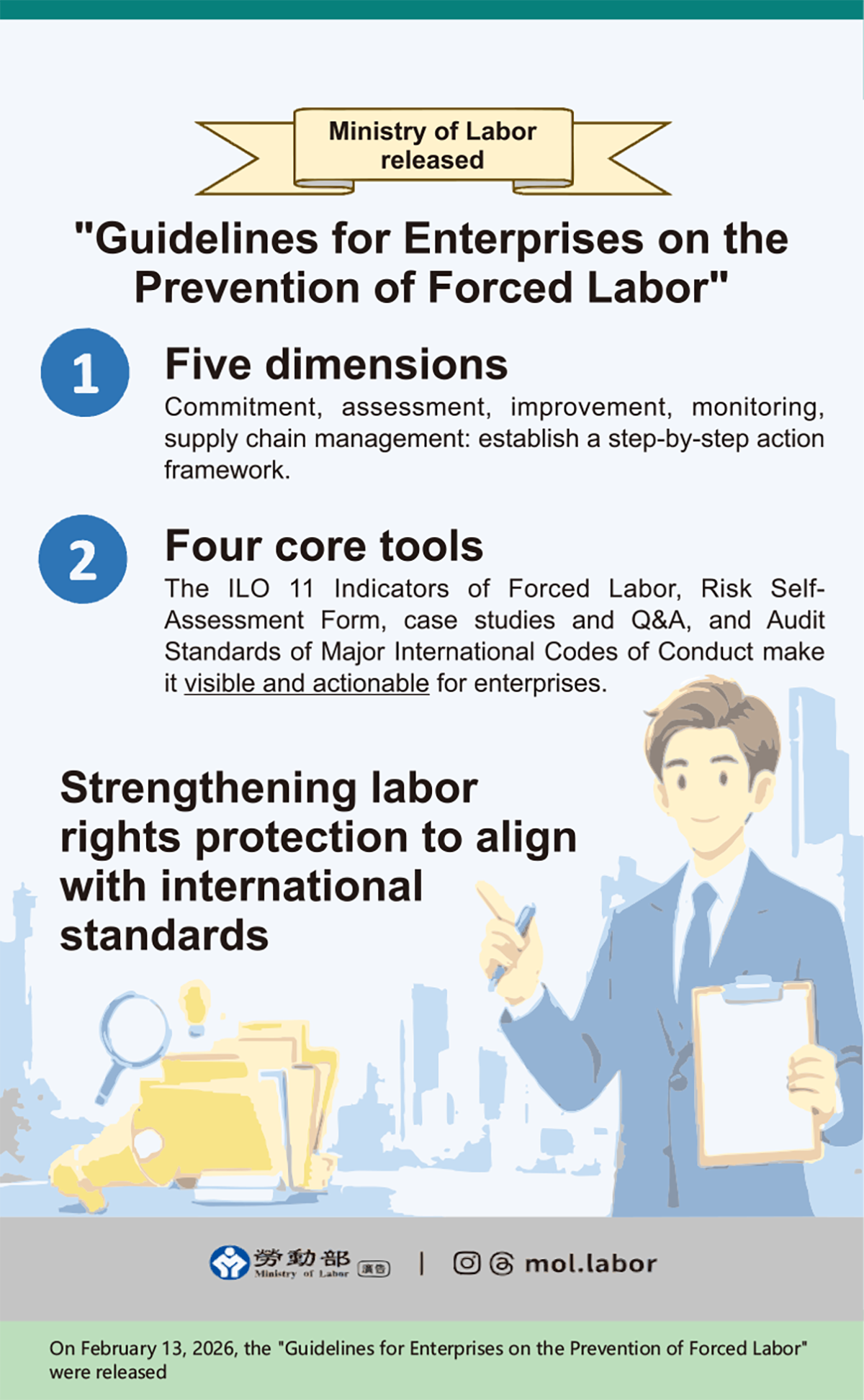
In response to the international supply chain's emphasis on preventing forced labor and adhering to fair recruitment principles, the Ministry of Labor (MOL) released "Guidelines for Enterprises on the Prevention of Forced Labor" on February 13, 2026. The guidelines help Taiwanese enterprises in identifying risks and reducing their operational risks.
The core of the guidelines is to guide enterprises, progressing from their own operations to the supply chain, step by step through five major dimensions: "policy commitment," "internal status assessment," "identification of potential risks," "response and improvement measures," and "supply chain management." Furthermore, to make it visible and actionable for enterprises, the guidelines provide four core tools: the ILO 11 Indicators of Forced Labor, the Forced Labor Risk Self-Assessment Form, the Audit Standards and Procedures of Major International Codes of Conduct, and the Q&A Collection. These tools help enterprises implement the guidelines more easily.
Preventing forced labor and implementing fair recruitment principles not only help safeguard workers' rights and interests, but are also a key factor for enterprises in maintaining international competitiveness and sustainable operations. Going forward, the MOL will continue to provide administrative support through inter-ministerial promotion and on-site guidance measures. This will help enterprises in protecting labor rights while simultaneously enhancing their corporate image and long-term competitive position in the global sustainable supply chain.
Keywords: Forced Labor, Fair Recruitment, International Supply Chains
Ministry of Labor Releases Reference Guidelines for Negotiation between Employers and Employees on Postponing Retirement Age and Reemployment after Retirement

For the purpose of encouraging senior workers to remain in the workforce, Article 54 of Taiwan's Labor Standards Act was amended on July 31, 2024, formally establishing that employers and employees may negotiate to postpone the retirement age. To facilitate smooth negotiations, the Ministry of Labor (MOL) has released the "Reference Guidelines for Negotiation between Employers and Employees on Postponing Retirement Age and Reemployment after Retirement." The guidelines address key considerations for negotiating the postponement of retirement age—including when negotiations may take place, how to prepare for negotiations, what to keep in mind during negotiations, and what resources are available to employers hiring senior workers. A negotiation record form for postponing retirement age is also provided for reference.
At the release of the guidelines, the MOL also invited Yulon Group and its enterprise union to share their experience of negotiation between employers and employees on postponing retirement. Yulon Group has long been proactive in retaining experienced talent through several approaches mentioned in the guidelines, including negotiating the postponement of retirement and rehiring retired employees. Only through mutual negotiation and discussion between employers and employees can both industry talent retention and worker needs be addressed, which benefits both labor and management.
The MOL particularly notes that when both parties agree to postpone the retirement age, the terms of the employment contract remain unchanged. The employer and employee continue under the original non-fixed term labor contract. During the negotiation process, if either party wishes to adjust working hours or the number of working days, this should also be mutually agreed upon through discussion and documented in writing. In cases of reemployment after retirement, negotiations may also be used to reach a mutual agreement on future working hours, number of working days, and other terms through a fixed-term contract. In addition to utilizing resources provided by the government, employers should also negotiate in good faith in a timely manner, so as to jointly create an age-friendly employment environment.
Keywords: Article 54 of the Labor Standards Act, Negotiating Postponed Retirement, Mandatory Retirement Age
Employers, Avoid These Pitfalls! The Ministry of Labor Highlights Three Key Points of the New Flexible Parental Leave System — Employers Should Proactively Foster a Family-Friendly Workplace to Help New Parents Balance Work and Family

The Ministry of Labor has compiled a Q&A on the Flexible Parental Leave without pay for raising children system and posted it on its official website. The following outlines the most common pitfalls for employers:
Key point 1: Companies may not establish internal rules for the sake of workforce scheduling that restrict parental leave without pay for raising children applications to only the first employee to apply or the first to complete a handover on any given day.
With regard to the application period, number of times, and procedures for unpaid parental leave for raising children, if an employee submits a request in accordance with the law, the employer must respect the employee's wishes. Employers should also remind employees that, barring special circumstances, parental leave without pay for raising children applications should generally be submitted at least five days in advance for the employer to handle scheduling.
Key point 2: In accordance with Article 84-1 of the Labor Standards Act, for workers who are required to work 10 hours a day, the number of family care leave hours for 7 days should be 70 hours, not 56 hours.
If the regular working hours per day originally agreed upon by the employer and employee are less than 8 hours, or more than 8 hours as permitted by law, the leave entitlement may be calculated accordingly based on that agreed amount. For example:
(I) For workers with 8 regular work hours per day and 40 regular working hours per week (including flex-time schedules spanning 2 or 4 weeks), the equivalent entitlement is 56 hours. (II) For workers with fewer than 8 regular work hours per day (for example, 7 regular work hours per day), the equivalent entitlement is 49 hours. (III) For workers covered under Article 84-1 of the Labor Standards Act (for example, those with 10 regular work hours per day), the equivalent entitlement is 70 hours.
Key point 3: When an employee returns to work after taking several days of unpaid parental leave for raising children, the 46-hour monthly cap on overtime hours may not be reset. Similarly, the number of personal leave and sick leave days is calculated on a calendar-year basis.
Under Article 32 of the Labor Standards Act, overtime hours may not exceed 46 hours per month. The start and end of each monthly cycle is to be agreed upon by the employer and employee and counted consecutively by the calendar. Even if an employee has taken unpaid parental leave for raising children or other leave, the agreed monthly cycle must continue to be counted consecutively without interruption. Additionally, personal leave and ordinary sick leave are calculated on a calendar-year basis as a general principle. Upon returning from unpaid parental leave for raising children, an employee's personal and sick leave balances are not reset. However, if a company has made arrangements more favorable than what the law requires, those arrangements shall prevail.
Keywords: Gender Equality in Employment Act, Parental Leave Without Pay for Raising Children, Family Care Leave
Ministry of Labor Targets High-Incident and High-Violation Workplaces and Worksites with New Enhanced Oversight Enforcement Plan
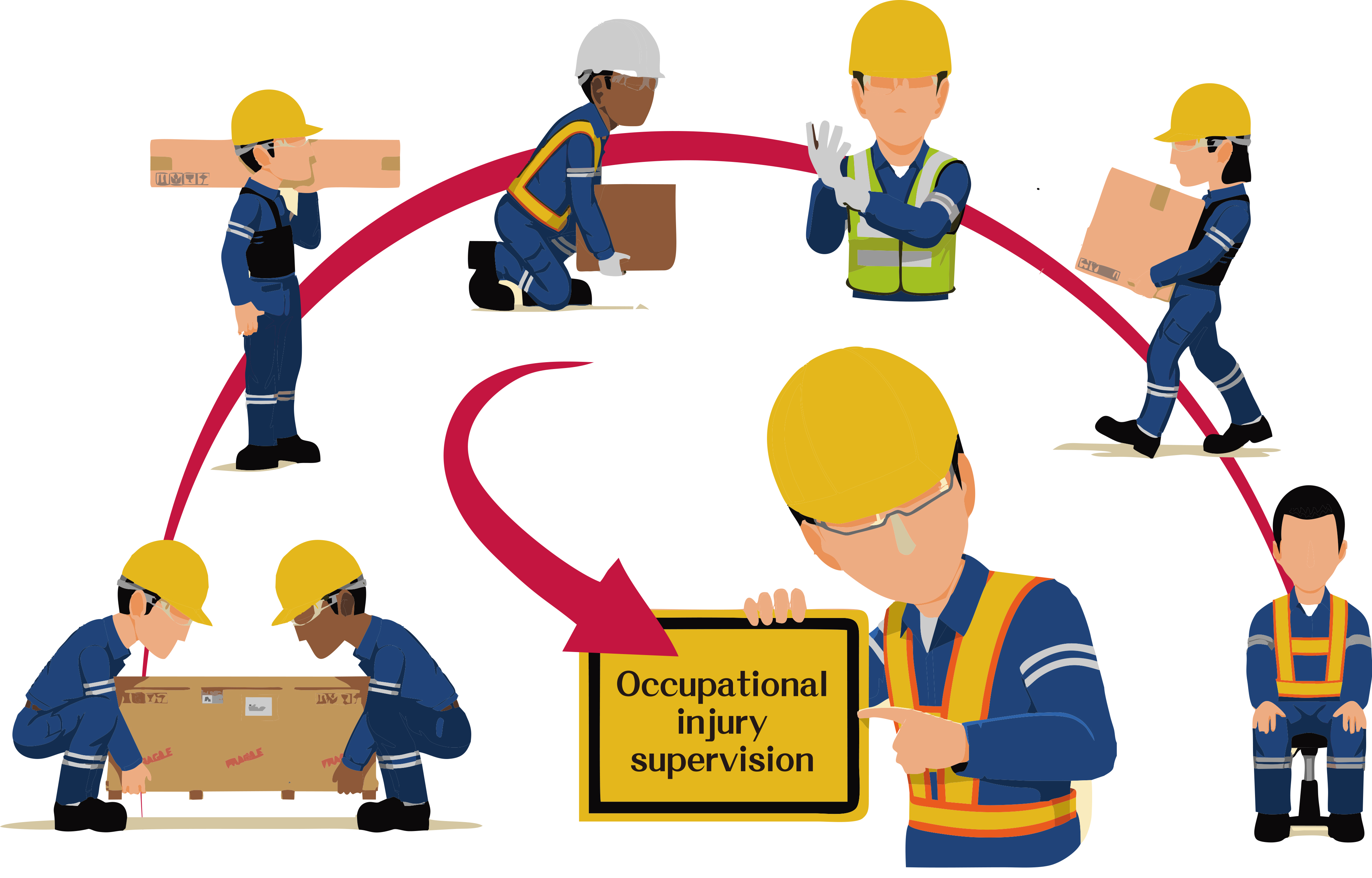
To strengthen supervision of industry establishments that repeatedly experience severe occupational accidents or persistently violate the Occupational Safety and Health Act, the Ministry of Labor (MOL) on January 28, 2026 issued an enhanced oversight enforcement plan for high-incident and high-violation workplaces and worksites, which establishes an enhanced oversight mechanism for high-risk industry establishments. Through a registration and monitoring system combined with public disclosure of information, the plan aims to prompt industry establishments to comprehensively review operational risks and implement safety and health improvements, thereby reducing the likelihood of serious occupational accidents.
The design of the system draws reference from international oversight mechanisms, including the United States' Severe Violator Enforcement Program (SVEP) and Singapore's Business Under Surveillance (BUS) program, and has been developed with input from practical labor inspection experience in Taiwan. The industry establishments subject to monitoring are primarily those that have experienced repeated serious occupational accidents within a 3-year period, or that have received work suspension orders or penalty dispositions 3 or more times within a single year for violations of the Occupational Safety and Health Act. By publicly disclosing the list of monitored industry establishments and strengthening oversight mechanisms, the plan aims to raise the level of attention establishments pay to occupational safety and health management, and to reinforce the management responsibilities of individual establishments.
In terms of oversight measures, industry establishments placed under monitoring are required to submit a safety and health improvement plan within 14 days. The implementation of this plan must be reviewed by a third-party external audit body, with monthly progress reports submitted to the labor inspection authority. In addition, the legal representative or chief executive of the industry establishment, as well as the relevant parent company or project owner, are required to personally attend review or examination meetings to present improvement measures and implementation status. This ensures that corporate management is actively engaged in safety and health oversight.
During the monitoring period, labor inspection authorities will conduct irregular inspections. If a business is found to have failed to implement its improvement plan as required, stricter penalties will be imposed in accordance with the law, and the scope of work suspension orders may be expanded. The monitoring period is in principle 6 months. An industry establishment may only be removed from the monitored list after a review confirms that actual improvements have been made and no further serious violations have occurred.
Through this dual approach of oversight and guidance, the mechanism aims to encourage high-risk industry establishments to continuously invest the necessary resources in strengthening safety and health management, reducing serious occupational accidents at the source and progressively raising overall workplace safety standards.
Keywords: Occupational Accident Oversight, Strengthening Accountability, Monitoring for Improvement
Building Inclusive Workplaces for Persons with Disabilities — Employers Can Receive Up to NT$300,000 Per Year Plus Additional Incentive Bonuses
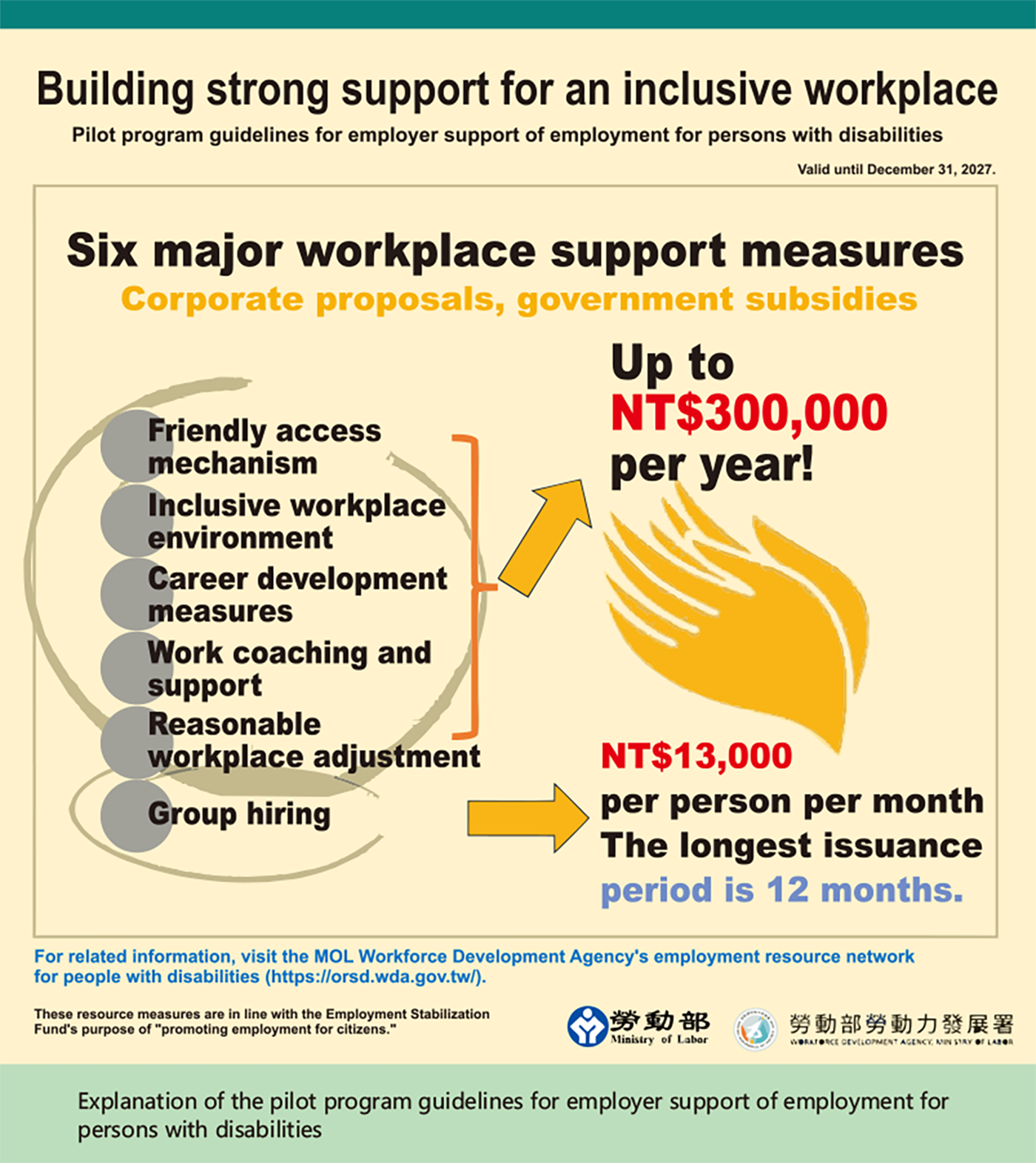
To ensure that employees with disabilities are not only able to "get in the door" but also "stay for the long term," the Ministry of Labor (MOL) has released pilot program guidelines for employer support of employment for persons with disabilities. For industry establishments that already employ workers with disabilities, any employer that hires 3 or more employees with disabilities and submits a workplace support plan may receive up to NT$300,000 in funding per year during the plan's implementation period. Employers who adopt a group hiring model may receive additional incentive bonuses. The pilot program runs through the end of 2027, with the goal of partnering with businesses to build inclusive workplaces.
To help more companies build internal support systems for the employment of persons with disabilities, the MOL has directly addressed common pain points faced by businesses by establishing a single service channel and a professional guidance team to provide consultation and coaching services to resolve management challenges. The MOL also offers disability-friendly workplace training courses to help businesses better understand the needs of persons with disabilities and the resources available to them. Additionally, employers may design a workplace support plan based on their actual needs, and upon review and approval by a branch office of the Workforce Development Agency under the MOL, may apply for disability workplace support subsidies. These subsidies comprehensively support businesses in establishing friendly hiring mechanisms, providing inclusive workplace environments, promoting career development measures, placing on-site job coaches, and implementing reasonable workplace accommodations and other inclusive measures. The maximum annual subsidy is NT$300,000 per employer.
The MOL also provides a group hiring incentive bonus to encourage businesses to hire persons with disabilities as part of a team. Employers who newly hire one or more persons with disabilities at the same worksite to work collaboratively alongside existing employees with disabilities, while also providing at least 2 workplace support measures, are eligible to apply for the subsidy. The subsidy is up to NT$13,000 per person per month, for a maximum of 12 months, totaling up to NT$156,000 per person. This amount is not counted toward the existing annual subsidy cap of NT$300,000, helping both employers and employees strengthen peer support and promote stable employment for persons with disabilities. For more detailed information, visit the MOL Workforce Development Agency's employment resource network for people with disabilities (https://orsd.wda.gov.tw/).
Keywords: Disabilities, Employer Support, Workplace Inclusion
- Source:Department of General Planning
- Publication Date:2026-04-30
- Count Views:
File
- Taiwan Labor E-Newsletter No86 pdf