


NO.89



- Last updated:2026-10-30
- Clicks on the following title, but browses this article fast
- Policies & Regulations Delivery Platform Management Law Takes Effect on July 21 to Build a Safer, More Transparent and Fairer Industry Environment Ministry of Labor and Ministry of Economic Affairs Join Forces to Establish a Review Mechanism for Restricting Imports of Goods Made With Forced Labor Ministry of Labor Amends the Enforcement Rules of the Labor Pension Act: Old-System-Only Workers Can Now Contribute Voluntarily and Settle Their Pensions Early by Agreement With Their Employer, Strengthening Retirement Security
- News Outlook 56th National Skills Competition Draws to a Close — President Hails Skilled Personnel as a Driving Force for Taiwan Delegation of US Labor Union and Labor Group Leaders Visits Taiwan for Exchanges Beating the Heat to Protect Workers! Ministry of Labor Field Demonstration Showcases Heat Protection Measures and Technology-Based Risk Reduction
Delivery Platform Management Law Takes Effect on July 21 to Build a Safer, More Transparent and Fairer Industry Environment

The Delivery Workers' Rights Protection and Delivery Platform Management Act (hereinafter the "Delivery Platform Management Law") officially took effect at midnight on July 21, 2026. To put the Delivery Platform Management Law into practice, the Ministry of Labor (MOL), the Ministry of Economic Affairs (MOEA), the Ministry of Transportation and Communications (MOTC), the Ministry of Health and Welfare (MOHW) and other agencies concerned worked closely for nearly six months to complete the supporting regulations authorized under the Act. Those regulations took effect alongside the Act and will create a safer, more transparent, and fairer delivery industry environment.
On the protection of delivery workers' rights, the MOL has issued enforcement rules and related regulations setting out how delivery workers' remuneration is calculated; the reasonableness of grounds for suspending or terminating a contract and the remedies available; transparency in order dispatch information; stronger commercial insurance coverage during delivery work; a new option allowing delivery workers to apply to platform operators for payment of labor occupational accident insurance; improved insurance requirements; and occupational safety education and training.
On the protection of partner merchants' rights, the MOEA has issued a Model Delivery Cooperation Contract to strengthen fairness in transactions between platforms and partner merchants.
On consumer protection and road safety management, the MOTC has given advance notice of the draft Mandatory and Prohibited Provisions for Standard Delivery Platform Service Contracts and the draft Rules for the Road Safety Management of Delivery Workers. The drafts strengthen member services, order cancellation and refunds, disclosure of transaction information and platforms' performance obligations. They also require platform operators to provide road safety education and training for delivery workers and to establish safety briefing and management mechanisms for serious traffic violations.
On food safety management, the MOHW has issued the Regulations Governing the Implementation of Food Hygiene and Safety Education and Training for Delivery Workers, requiring platform operators to provide such training in order to safeguard food safety for consumers.
The MOL has set up a Delivery Worker Rights Protection section on its website and will continue its outreach efforts and establish a standing communication mechanism to bring together delivery platform operators, delivery workers' unions, and relevant agencies to exchange views on practical questions, types of disputes, and obstacles arising from implementation, and to work out appropriate handling principles, so that the new system gets off to a smooth start.
The MOL calls on delivery platform operators to comply fully with the law and to work together to create a safer, fairer, more transparent and more sustainable delivery service environment.
Keywords: Delivery Platform Management Law, Delivery Workers, Platform Operators
Ministry of Labor and Ministry of Economic Affairs Join Forces to Establish a Review Mechanism for Restricting Imports of Goods Made With Forced Labor

On July 30, 2026, the Ministry of Economic Affairs (MOEA) and the Ministry of Labor (MOL) issued the Operational Guidelines for Restricting the Importation of Forced Labor Goods and the Guidelines for the Establishment of the Review Committee on the Restriction of Importation of Forced Labor Goods, respectively. Together, the two sets of guidelines establish a mechanism for reviewing and restricting imports of goods made with forced labor, putting Taiwan in step with the United States and other partner countries. The mechanism brings Taiwan's labor rights protections in line with international practice while preventing low-priced goods that create unfair competition from entering the market and maintaining a level playing field for domestic businesses. The MOL noted that Taiwan has committed, under its agreement with the United States, to enforcing a ban on imports of goods made with forced labor. On July 23, the Office of the United States Trade Representative (USTR) announced that it had sorted 60 US trading partners into four tariff groups according to their implementation of forced labor policies. Taiwan and the European Union were placed in the relatively preferential tariff group in this review, at a rate of 10% that is not added to the most-favored-nation (MFN) tariff rate.
After receiving information forwarded by the MOEA on goods identified by partner countries as produced with forced labor, the MOL will join the MOEA in convening the Review Committee on Restricted Imports of Goods Produced With Forced Labor to determine the entities involved and the scope of the goods concerned. The MOL explained that the review committee is convened jointly by the MOEA and the MOL with the participation of relevant agencies, and is responsible for reviewing import restriction cases, handling review procedures and coordinating among ministries. Once a case is confirmed, the competent authorities designated under the Foreign Trade Act and the Act for the Establishment and Management of Free Trade Zones will announce the import restriction, and the Customs Administration of the Ministry of Finance (MOF) will carry out border inspections to keep goods made with forced labor out of Taiwan. Temporary import restrictions will also apply while a case is under review.
The MOL stressed that bringing labor rights into line with international standards has become essential for industries competing on the global stage. Beyond establishing the review mechanism for restricting imports of goods made with forced labor, the MOL will continue to monitor companies' compliance with the Reference Guidelines for Enterprises on Preventing Forced Labor, helping domestic industries reduce both forced labor risks and business risks. Further information is available in the Forced Labor Prevention section of the MOL website.
Keywords: Forced Labor, Restrictions on Imports of Goods Made With Forced Labor, Forced Labor Prevention Section
Ministry of Labor Amends the Enforcement Rules of the Labor Pension Act: Old-System-Only Workers Can Now Contribute Voluntarily and Settle Their Pensions Early by Agreement With Their Employer, Strengthening Retirement Security

To strengthen the pension rights of workers who were covered by the Labor Standards Act before the Labor Pension Act took effect, who have remained with the same business entity since then and who chose to remain under the pension system of the Labor Standards Act ("old-system-only workers"), the Ministry of Labor (MOL) has amended the Enforcement Rules of the Labor Pension Act in line with the plan on voluntary contributions and early pension settlement for old-system-only workers approved by the Executive Yuan. The amendments were promulgated on July 15, 2026, giving eligible workers more flexibility in planning for retirement and greater peace of mind for the future.
The amendments cover Articles 21-2, 21-3 and 21-4 of the Enforcement Rules of the Labor Pension Act. The key points are as follows: Old-system-only workers may voluntarily contribute up to 6% of their monthly wages toward their pensions, building up their pension through their own savings. An old-system-only worker who has begun making voluntary contributions and who meets the retirement requirements of the Labor Standards Act may, during the term of the employment contract and by mutual agreement between employer and employee, settle in advance the pension accrued for years of service under the Labor Standards Act. To safeguard workers' financial needs after retirement, the settled pension must be transferred in full into the worker's individual pension account at the Bureau of Labor Insurance (BLI). Finally, where an employer and employee have agreed to settle the pension, once the employment contract is lawfully terminated, the employer must still calculate and pay a pension for the years of service the worker accrues by continuing to work. Employers and employees may also agree to settle the pension accrued from continued service on a year-by-year basis, with the full amount transferred to the worker's individual pension account at the BLI after each settlement.
The amended provisions were promulgated on July 15, 2026 and took effect on July 17, 2026. To help employers and employees better understand the amendments to the Enforcement Rules of the Labor Pension Act, a series of briefing sessions will be held. Forms, frequently asked questions (FAQs) and procedural guidance will also be made available progressively in the dedicated section on voluntary contributions and early pension settlement for old-system-only workers. For further questions, please call the MOL's toll-free hotline at 1955.
Keywords: Labor Pension Act, Old-System-Only Workers, Voluntary Pension Contributions, Pension Settlement
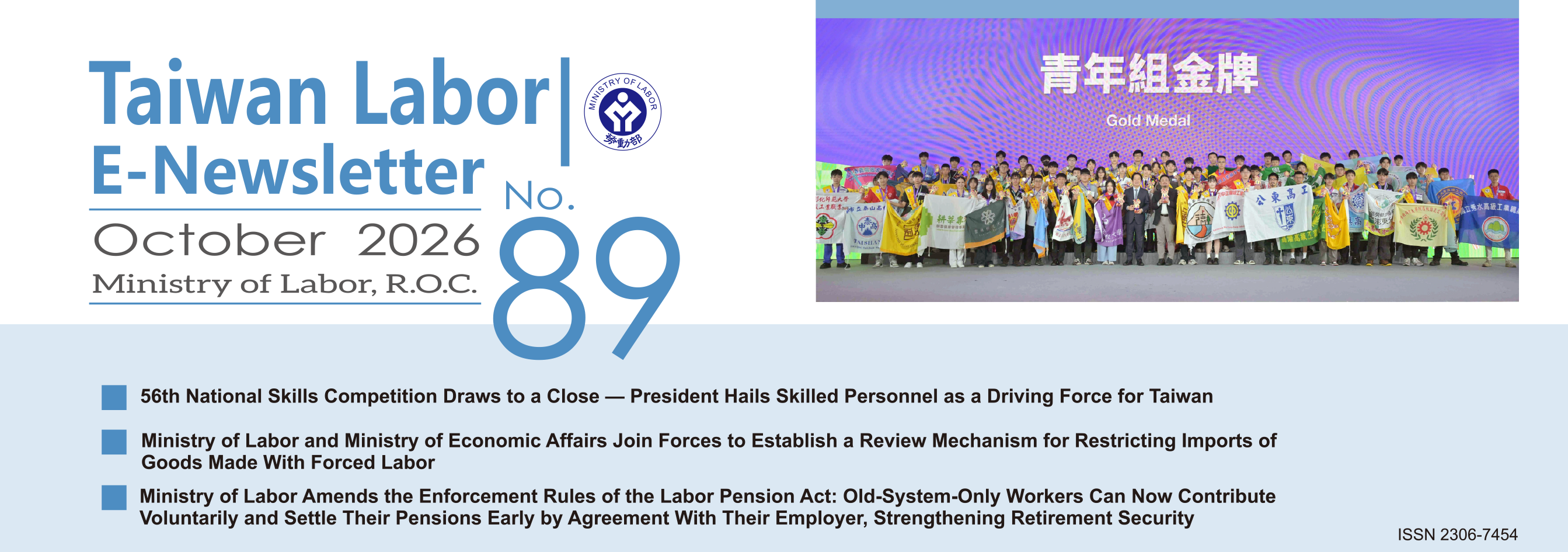
56th National Skills Competition Draws to a Close — President Hails Skilled Personnel as a Driving Force for Taiwan
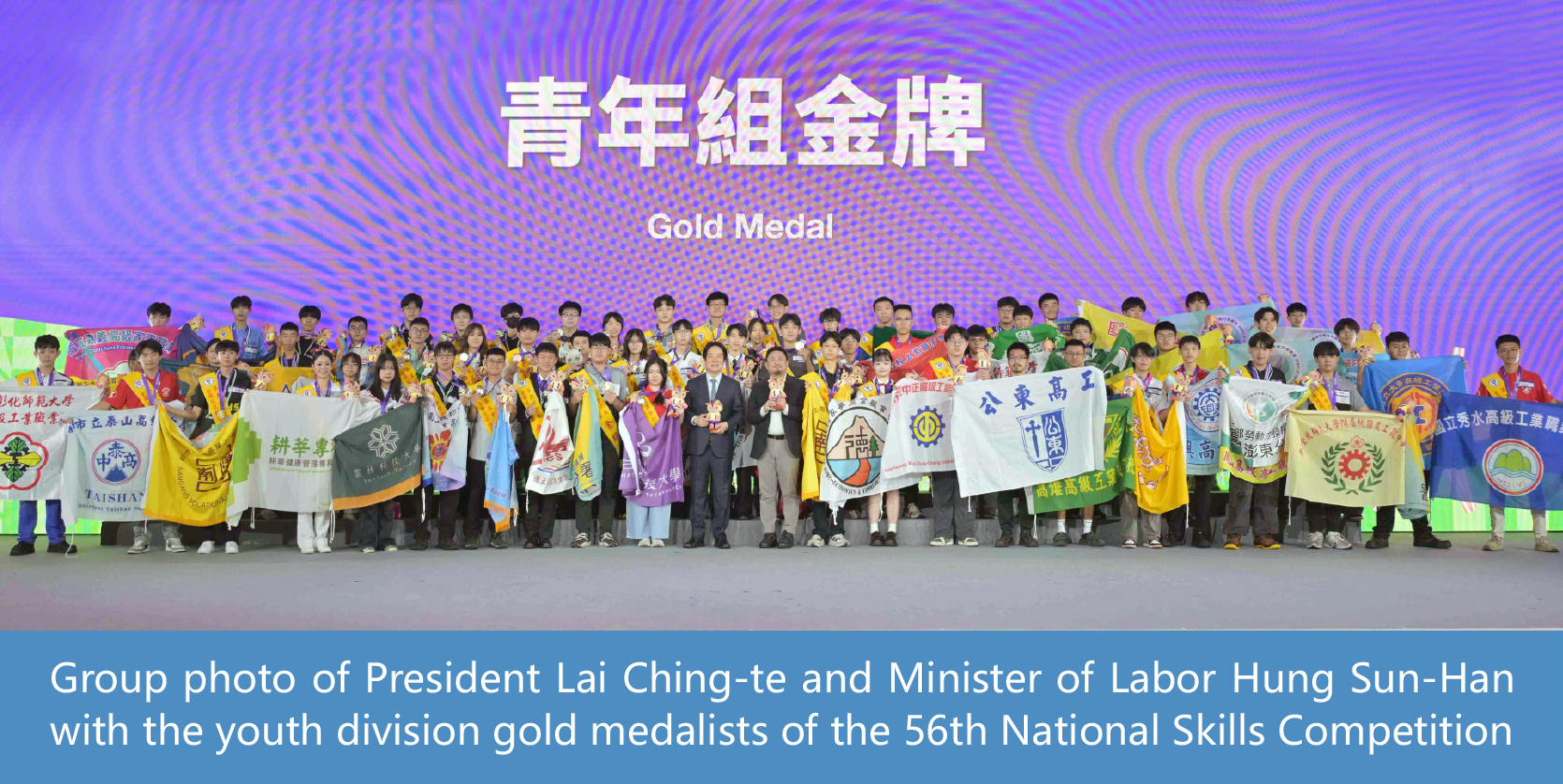
The 56th National Skills Competition came to a successful close on August 2, 2026 at the Taipei Nangang Exhibition Center. President Lai Ching-te and Minister of Labor Hung Sun-Han attended the closing and awards ceremony, where President Lai presented the gold medals in the 55 skills, recognizing the competitors' long-term commitment to training and to honing their professional skills.
This year's competition featured 55 youth skills and 13 junior skills. Altogether 1,070 competitors took part. The competitors had come through multiple rounds of selection in regional competitions and skills contests. On the day, tested on technique, speed and quick thinking, they showed focus, discipline, resilience under pressure and the ability to solve problems.
President Lai said the National Skills Competition is the highest stage for skills competition in Taiwan. Medals may be gold, silver, or bronze, he noted, but every skill is a profession in its own right, and every competitor who holds nothing back and finishes the competition is a winner. Taiwan's international reputation for manufacturing rests on skills built up over many years by skilled personnel in every industry. The government will continue investing in technical and vocational education and linking industry, academia, training and employment, helping young people build their expertise and compete internationally. He expressed hope that the competitors would use their skills to achieve their dreams and their expertise to strengthen Taiwan.
Minister Hung said that behind every competitor's appearance on the national stage are months or years of practice, amounting in some cases to thousands of hours, and one fresh start after another following mistakes. Results matter, he said, but the concentration, discipline, resilience, and problem-solving ability built through training are assets that will stay with competitors over the long run. The Ministry of Labor (MOL) will go on linking every stage of skills development — skills introduction, training, competition, further study, internships and employment — and will use company visits, project collaborations, internship training and job matching to close the gap between the competition floor and the workplace, so that skills are genuinely seen and genuinely valued.
A total of 547 experts and chief experts took part in this year's competition, working alongside schools at every level, training institutions, co-organizers, corporate sponsors, and logistics teams to deliver an event on this scale. The MOL also thanked everyone who has supported the cultivation of skilled personnel.
Keywords: 56th National Skills Competition, 2026 WorldSkills Competition, Skilled Personnel
Delegation of US Labor Union and Labor Group Leaders Visits Taiwan for Exchanges

On the morning of August 31, 2026, Deputy Minister of Labor Huang Lin-Na met with a seven-member delegation of leaders from US labor unions and labor organizations. Its members came from across the American labor world: the workers' rights NGO Verité, the International Brotherhood of Teamsters (IBT), the Washington, D.C. Chapter of the Labor and Employment Relations Association (DC LERA), the International Association of Fire Fighters (IAFF), the American Federation of Government Employees (AFGE), the Oregon Nurses Association (ONA) and the International Organization of Masters, Mates & Pilots (MM&P).
Every two years since 2013, the Ministry of Labor (MOL) has invited US union leaders to visit Taiwan, deepening Taiwan-US cooperation on labor affairs through union visits, roundtables and practical exchanges. The two sides also engaged in in-depth discussions and shared experiences on forward-looking labor issues, among them the outcomes of Taiwan's legislation on delivery platforms and the impact of artificial intelligence on workers in the workplace and corresponding responses.
While in Taiwan, the delegation also joined a Taiwan-US union roundtable, where participants traded practical experience on case studies in collective bargaining, on tracking compliance for products and labor rights in global supply chains, and on how labor relations work in the United States today. The delegation went on to visit unions in telecommunications, aviation, shipping, nursing and the railways. These on-site exchanges gave the American side a clearer picture of how Taiwan's unions have developed and of Taiwan's labor environment, and it further deepened the two countries' partnership on labor affairs.
Keywords: American Union Leaders' Delegation, Taiwan-US Labor Affairs, International Exchange
Beating the Heat to Protect Workers! Ministry of Labor Field Demonstration Showcases Heat Protection Measures and Technology-Based Risk Reduction
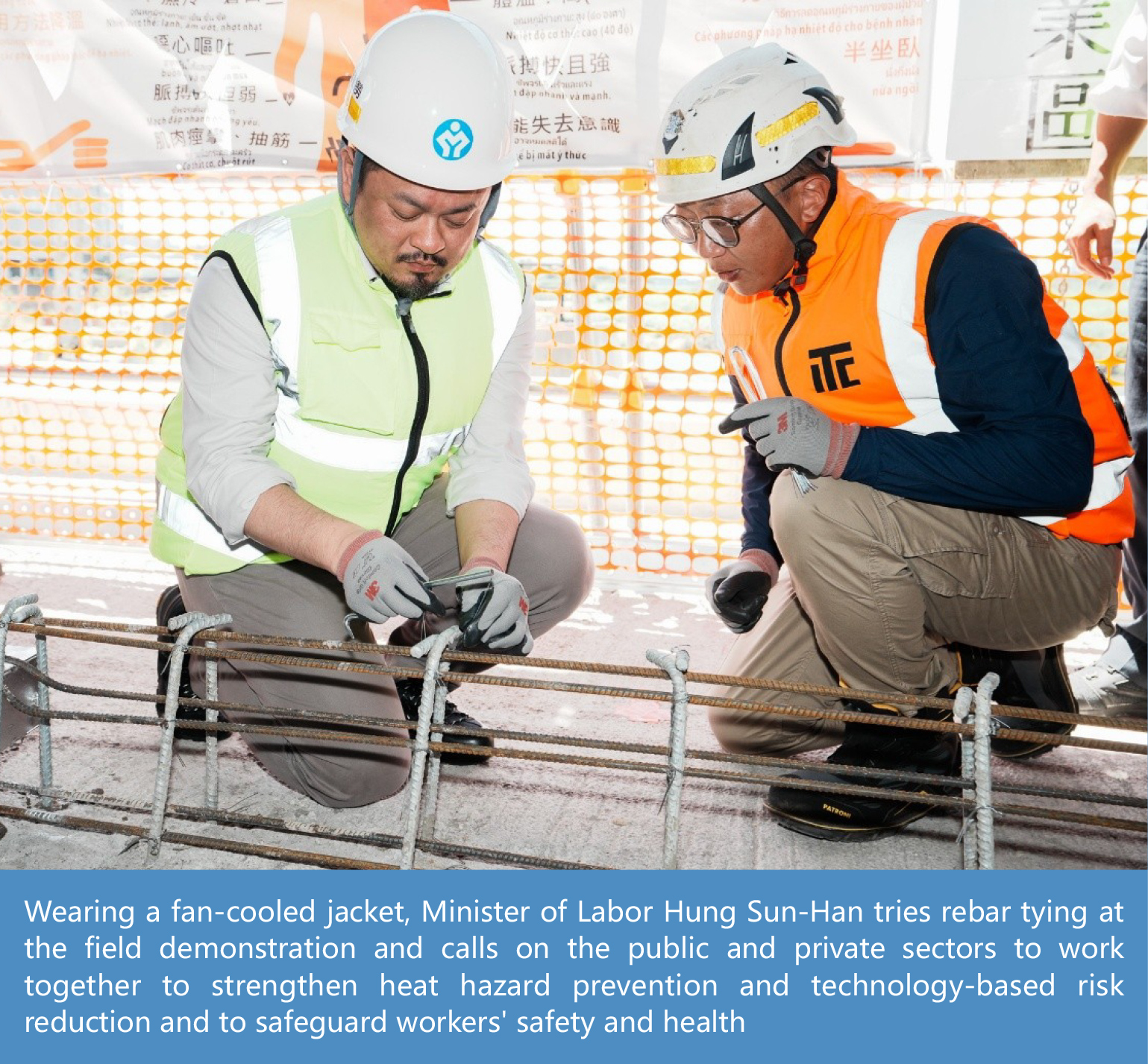
To help industry establishments do more to prevent heat-related hazards, the Occupational Safety and Health Administration (OSHA) of the Ministry of Labor (MOL) held a demonstration on heat hazard prevention and technology-based risk reduction in the construction industry at a bridge reconstruction site on July 17. Minister of Labor Hung Sun-Han attended in person, tried his hand at tying rebar and thanked the frontline workers for their hard work, calling on the public and private sectors to work together to strengthen heat hazard prevention and technology-based risk reduction and to keep workers safe and healthy.
Minister Hung said that with extreme weather bringing ever higher temperatures, heat hazard prevention has become indispensable to protecting workers' health. Alongside continued inspections and the heat hazard improvement tracking and audit mechanism, which push industry establishments to implement protective measures for high-temperature work, the MOL has set up a single service window and an online platform to make it easier for small and micro enterprises to obtain subsidies for cooling equipment and heat protection gear. In addition, recently amended provisions of the Occupational Safety and Health Act took effect on July 1. The original business entities and their contractors must now jointly identify the risks of high-temperature work and implement protective measures, so that preventing heat hazards is no longer the responsibility of frontline workers alone but a statutory duty shared by employers and contractors at every tier.
OSHA noted that hazards associated with high-temperature work are highly preventable. Risk assessments should be carried out in advance, protective measures put in place and smart technology used to support management. Going forward, OSHA will continue to work with industry through regulatory systems, education and outreach, oversight and inspection, and the application of technology to improve heat hazard prevention and build safer, healthier, and more resilient workplaces.
Keywords: High Temperatures, Heat Hazards, Technology-Based Risk Reduction
- Source:Department of General Planning
- Publication Date:2026-10-30
- Count Views:
File
- Taiwan Labor E-Newsletter No89 pdf