


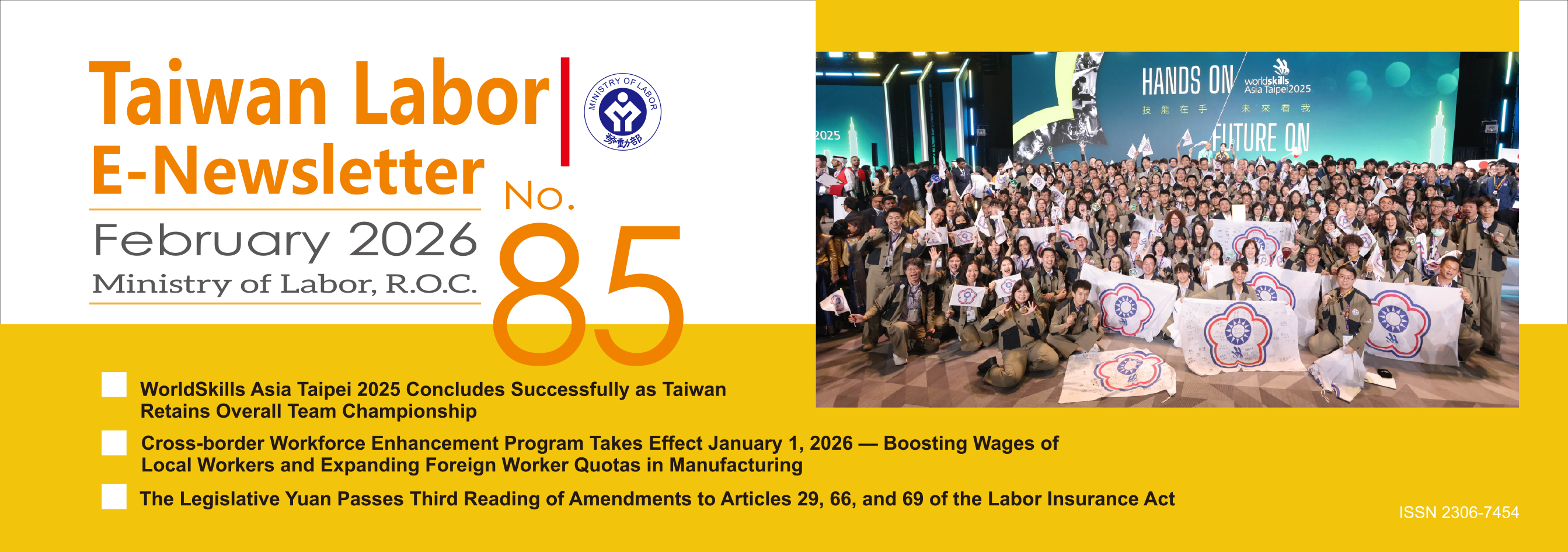
NO.85



- Last updated:2026-02-24
- Clicks on the following title, but browses this article fast
- Policies & Regulations Cross-border Workforce Enhancement Program Takes Effect January 1, 2026 — Boosting Wages of Local Workers and Expanding Foreign Worker Quotas in Manufacturing President Issues Amendments to Specific Provisions of the Occupational Safety and Health Act The Legislative Yuan Passes Third Reading of Amendments to Articles 29, 66, and 69 of the Labor Insurance Act
- News Outlook Ministry of Labor Held APEC Workshop on "Promoting a Human-Centered AI Workplace: Transparency and Worker Welfare" WorldSkills Asia Taipei 2025 Concludes Successfully as Taiwan Retains Overall Team Championship Occupational Safety and Health Administration of Ministry of Labor and International Association of Labour Inspection Held Exchange and Cooperation Meeting
Cross-border Workforce Enhancement Program Takes Effect January 1, 2026 — Boosting Wages of Local Workers and Expanding Foreign Worker Quotas in Manufacturing
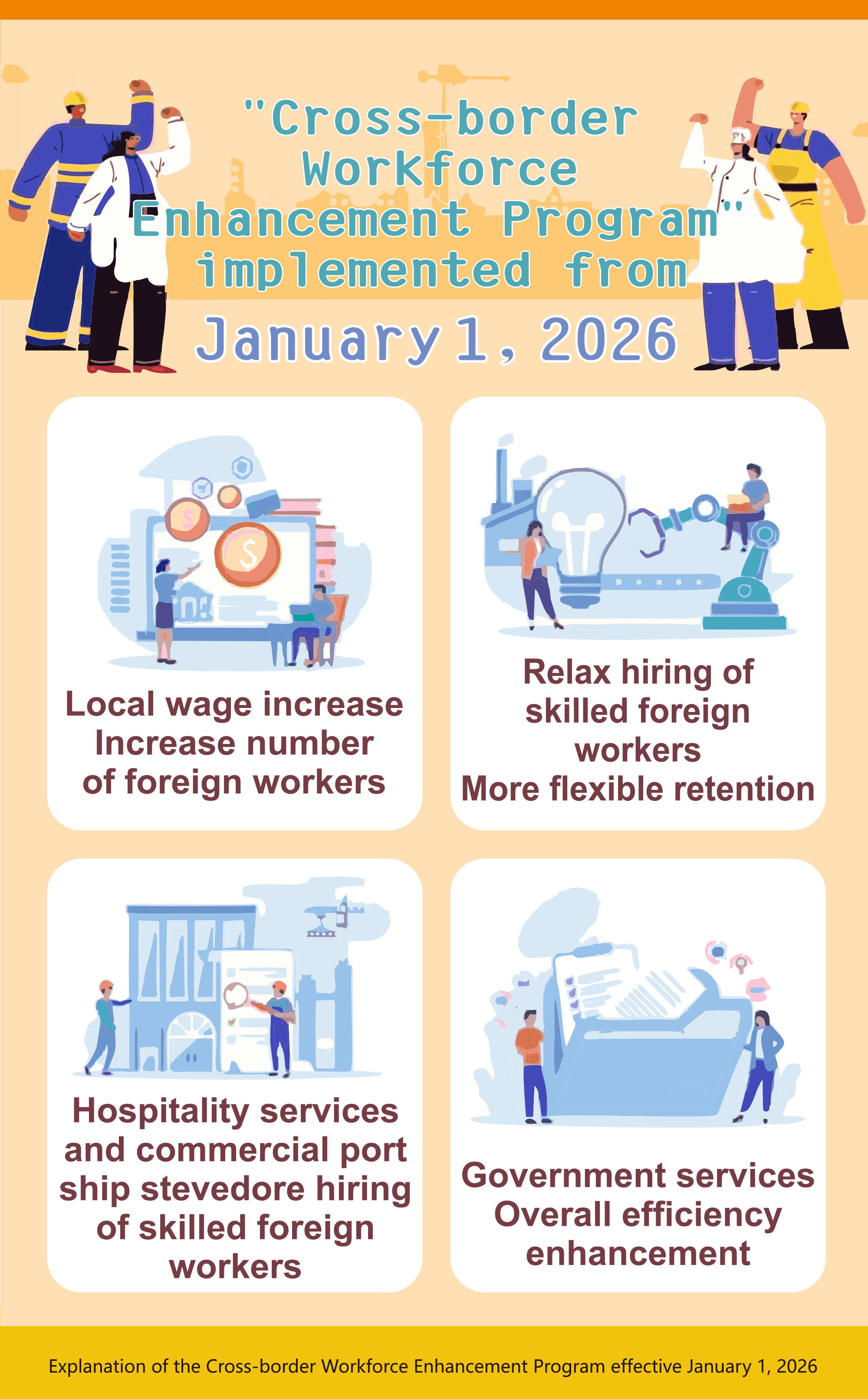
To address workforce challenges arising from Taiwan's declining birth rate and aging population, the Ministry of Labor (MOL) has launched the Cross‑border Workforce Enhancement Program, with related regulations taking effect on January 1, 2026. Through measures such as raising wages for local workers in the manufacturing sector, increasing foreign worker quotas linked to local wage growth, expanding overseas recruitment of skilled foreign workers, and relaxing retention restrictions, the program aims to help companies stabilize their workforce structure while supporting wage growth and protecting the employment rights of local workers.
- Hospitality services and commercial port ship stevedore sectors raised wages of local workers in conjunction with the direct overseas introduction of skilled foreign workers
Following the launch of the program, employers in the hospitality services and commercial port ship stevedore sectors are permitted to hire skilled foreign workers, who must be directly recruited from overseas through the new cross-border recruitment mechanism. Employers may increase the wages of their local rank-and-file full-time workers. For each local worker whose wages are increased, one additional foreign skilled worker may be added to the quota, provided that the total increase does not exceed 10% of the number of workers covered by labor insurance. The recruitment of skilled foreign workers will be conducted through cross-border recruitment center, facilitating direct, country-to-country employment and fostering a fair and friendly environment for international labor recruitment.
- Wage increases for local rank-and-file workers and expanded manufacturing foreign worker quotas; comprehensive relaxation of skilled foreign worker retention limits
The MOL stated that to help address the rank‑and‑file labor needs of the manufacturing industry and promote higher wages for local workers, the Cross‑border Workforce Enhancement Program has introduced a new additional quota mechanism that allows manufacturing employers to expand their foreign worker allocation when they increase local employees' wages. Under the existing 3K5 system and the Extra system (additional employment stabilization fee mechanism), manufacturing employers may increase the wages of their local full-time rank-and-file workers. For each local worker whose wages are raised, employers may hire one additional temporary foreign worker beyond their existing quota, provided that the total number of additional foreign workers does not exceed 10% of workers covered by labor insurance. As a result, the total cap on foreign worker quotas for manufacturing employers can be raised from the original 40% to 45% of the workforce covered by labor insurance.
Manufacturing employers are now permitted to retain all experienced foreign workers who meet the criteria for conversion to skilled foreign worker, and the cap on skilled foreign worker allocation has been increased from 25% to 100%, enabling employers to retain senior foreign workers as skilled foreign workers.
The MOL stated that, while stabilizing employment opportunities for Taiwanese citizens, it will actively supplement the workforce needed by industries, assist enterprises in sustainable operation, and at the same time ensure the rights and interests of local workers, thereby creating a more competitive and resilient labor market.
Keywords: Enhancement Program, Local Wage Increases, Skilled Foreign Worker
President Issues Amendments to Specific Provisions of the Occupational Safety and Health Act

The amended Occupational Safety and Health Act was promulgated through Presidential Order No. 11400130481 issued by the President of Taiwan on December 19, 2025. A total of 25 articles were amended (including 6 new articles). The primary purposes of this amendment are to achieve comprehensive industrial safety prevention and to institutionalize the prevention of workplace bullying. The key points of the amendment include:
I. Strengthening disaster prevention in the initial phases of construction projects: To reduce occupational hazards in construction and maintenance projects, the amendment stipulates that when project owners commission the planning, design, and construction of projects above a certain scale, they must analyze potential hazards based on the characteristics of the project, prepare safety and health drawings, specifications, and budgets, and ensure that construction companies adopt appropriate preventive measures and equipment.
II. Strengthening safety management during contracting: When contracting out projects, business entities must conduct risk assessments and provide hazard notifications accordingly. When renting or lending workplaces or equipment, they shall complete hazard notifications in advance. Furthermore, the scope of joint operation management shall be expanded to include enhanced disaster prevention and access control measures.
III. Improving workplace bullying prevention: (I)Provide a clear definition of workplace bullying, while employers should establish complaint channels, regulations, and prevention measures based on the size of the organization. (II)Strengthen the investigation and handling mechanism for internal complaints of workplace bullying, and provide assistance and protection measures for complainants. Complaint cases and their outcomes must be registered on the website designated by the central competent authority. (III)Mechanisms for external appeals, investigations, and handling should be established for cases in which the person accused of workplace bullying is the most senior executive.
IV. Criminal penalties, fines, and administrative sanctions should be appropriately increased to deter unlawful conduct and meet societal expectations.
V. For those who violate the regulations, published information will include the date of the penalty, the specific clause violated, and the amount of the fine. For occupational accidents, published information will include the date, location, and number of casualties.
The Ministry of Labor (MOL) stated that this amendment is a tangible expression of the government's continuous commitment to enhancing the occupational safety and health system and protect workers' rights. To ensure the amendment's objectives are realized both legally and in practice, the MOL has begun drafting and revising relevant subordinate regulations and planning supporting measures, with the aim of building safer, healthier, and more worker‑friendly workplaces.
Keywords: Occupational Safety and Health, Workplace Bullying, Disaster Prevention in the Initial Phases of Construction Projects
The Legislative Yuan Passes Third Reading of Amendments to Articles 29, 66, and 69 of the Labor Insurance Act
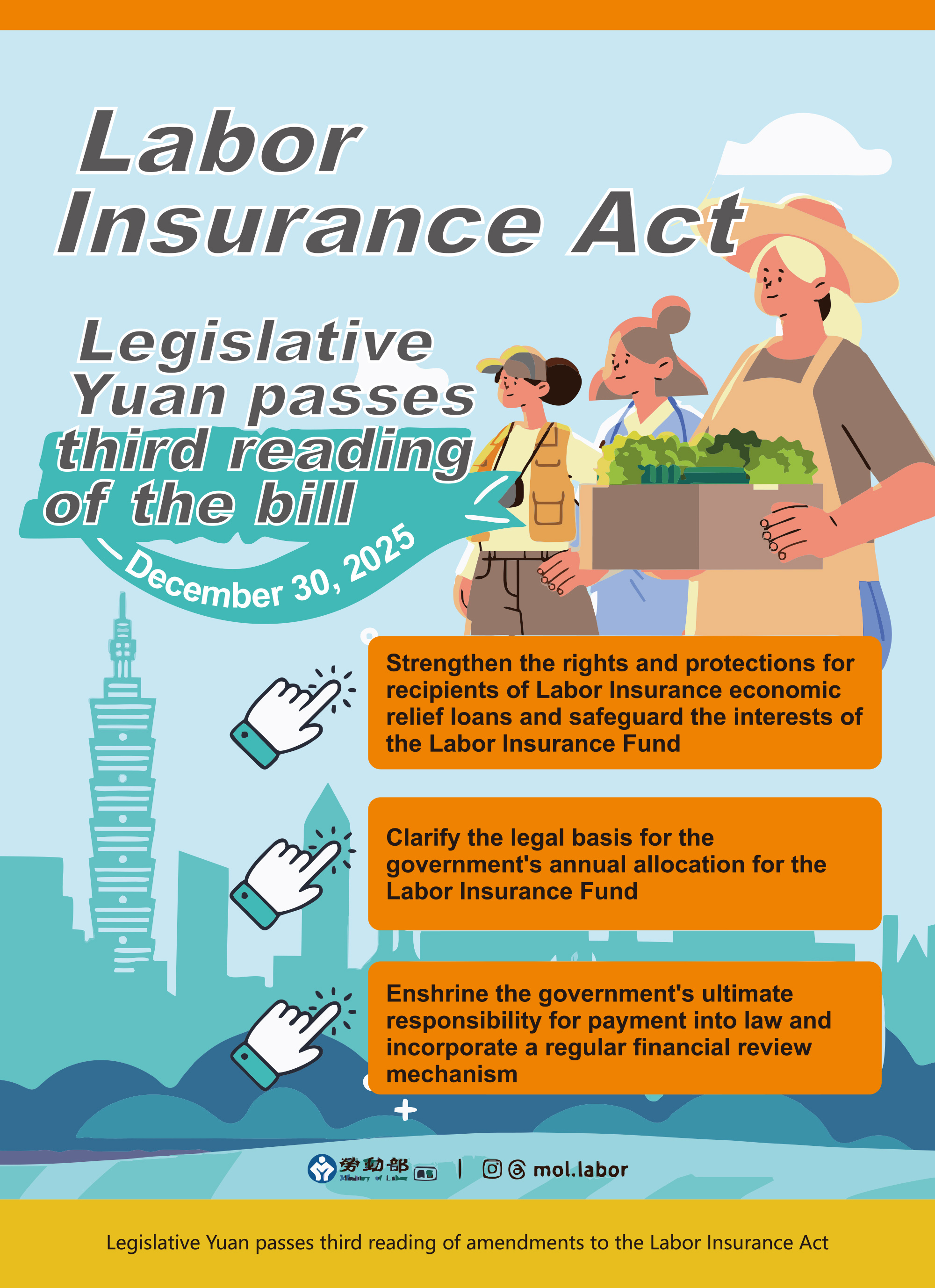
The Legislative Yuan passed its third reading of the amendments to Articles 29, 66, and 69 of the Labor Insurance Act on December 30, 2025 (The amended provisions were promulgated by presidential decree on January 21, 2026.). This amendment is designed to stabilize the flow of the Labor Insurance Fund and protect the rights and interests of the insured persons. By incorporating government subsidies and the central government's ultimate payment responsibility into law, it demonstrates the government's determination and commitment to ensuring the sound operation of the labor insurance system.
As the Ministry of Labor explained, the key points of this amendment to the Labor Insurance Act are as follows:
I. Strengthen the rights and protections for recipients of Labor Insurance economic relief loans and safeguard the interests of the Labor Insurance Fund
To fulfill the purpose of Labor Insurance economic relief loans for insured persons and help ease their short-term financial difficulties, the law now specifically allows applicants to open a designated account for depositing the loan principal. The deposit held in the designated account may not be used as the instrument for offsetting, seizure, or as guarantee or court seizure.
To uphold public interest and the principle of equality between the obligations to pay premiums and the rights to claim benefits under social insurance, the amendment clarifies that Labor Insurance premiums and late fees are excluded from debt relief and statute-of-limitations provisions, consistent with Article 25 of the Labor Occupational Accident Insurance and Protection Act. This ensures the Labor Insurance Fund's claims are protected and supports the sound development of the labor insurance system.
II. Clarify the legal basis for the government's annual allocation for the Labor Insurance Fund
The amendment specifies that the Labor Insurance Fund's sources of financing include government subsidies as well as other financial contributions and related income. The central competent authority is required to allocate an annual budget to subsidize the Labor Insurance Fund based on the government's fiscal condition and the fund's financial status. If premium income in a given year is insufficient to cover insurance benefit expenditures, the government shall allocate appropriate funds or provide subsidies to ensure the fund's stability.
III. Enshrine the government's ultimate responsibility for payment into law and incorporate a regular financial review mechanism
The amendment stipulates that the central government bears the ultimate responsibility for Labor Insurance finances and incorporates a mechanism to review insurance finances at least every three years to ensure the basic economic security of elderly workers.
Keywords: The Applicant for Labor Insurance Economic Relief Loans Open a Designated Account, the Government Allocation of Labor Insurance Fund, Enshrining the Government's Ultimate Responsibility for Payment into Law
Ministry of Labor Held APEC Workshop on "Promoting a Human-Centered AI Workplace: Transparency and Worker Welfare"
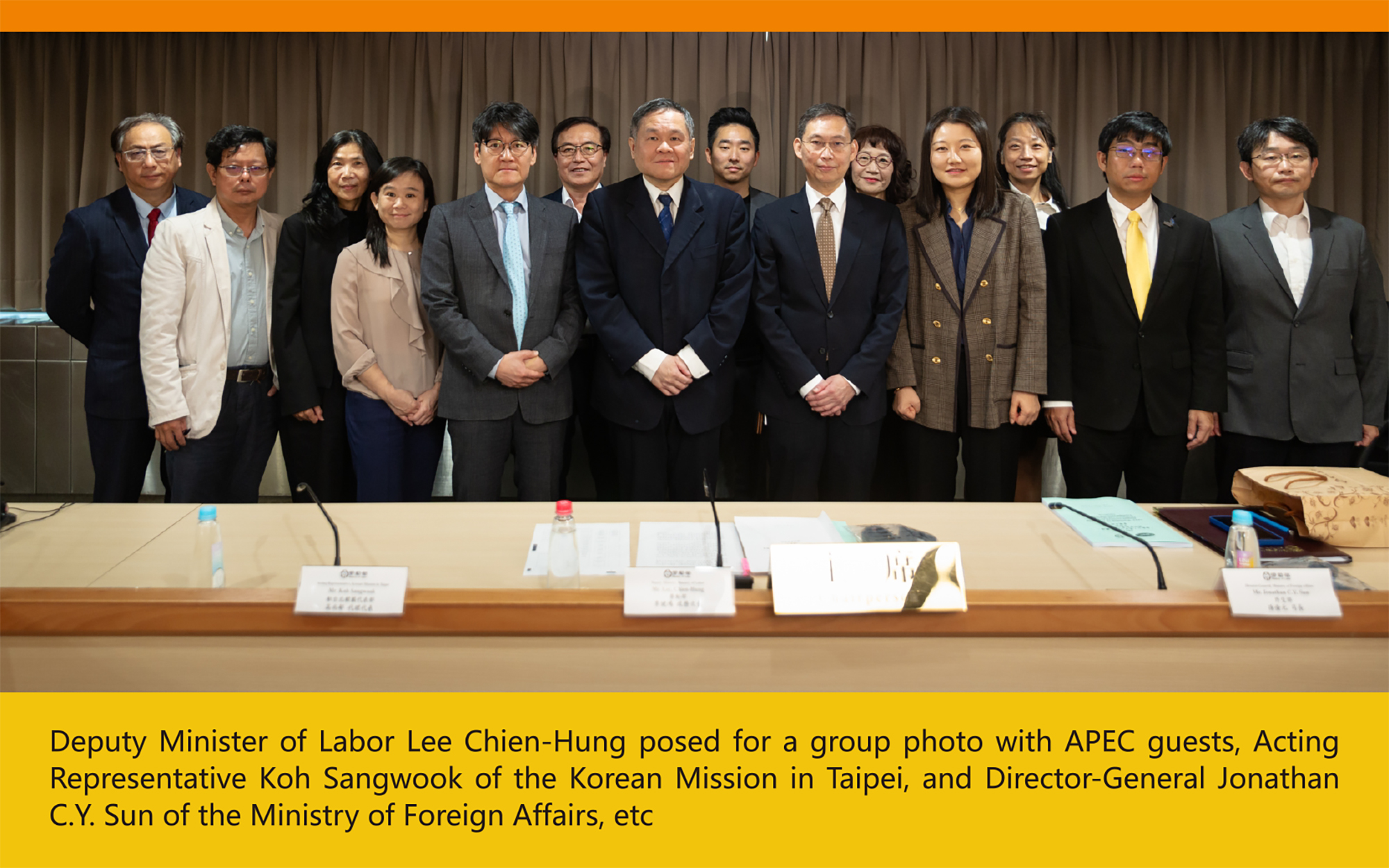
The Ministry of Labor (MOL) held an APEC workshop on "Advancing a Human‑Centered AI Workplace: Transparency and Welfare" on November 26, 2025, with the opening ceremony presided over by Deputy Minister Lee Chien‑Hung. This workshop invited government representatives from economies including the Republic of Korea, Japan, Thailand, and the Philippines, while representatives and experts from domestic and international labor and employment organizations — including the International Trade Union Confederation (ITUC), IndustriALL, WCC‑group, Chinese Federation Of Labour, Taiwan Confederation of Trade Unions, Chinese National Federation of the Industries, and the Taiwan Artificial Intelligence Association — shared best practices and experiences on trends and countermeasures regarding privacy risks in the promotion of AI in the workplace.
Through the exchange of experiences and perspectives among participating economies, the MOL will develop policy recommendations and best‑practice models based on the outcomes of this workshop, and continue to deepen regional cooperation through the APEC platform to create a transparent, trustworthy, and sustainable smart work environment for workers.
Keywords: APEC, Human Resources Development Working Group (HRDWG), AI
WorldSkills Asia Taipei 2025 Concludes Successfully as Taiwan Retains Overall Team Championship
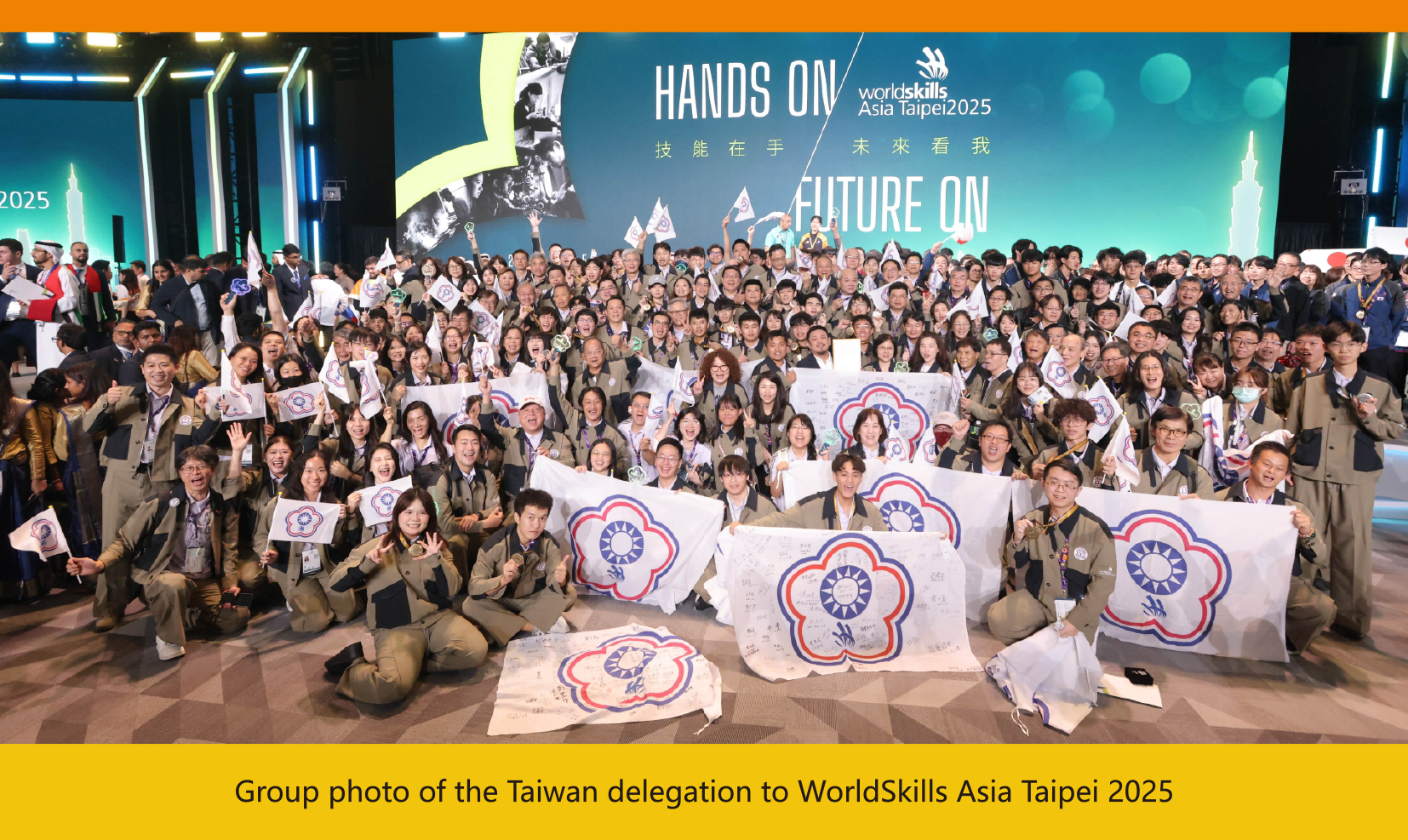
WorldSkills Asia Taipei 2025 concluded successfully on November 29, 2025. This year's event was held in Taiwan for the first time, and Taiwanese competitors delivered an outstanding performance, winning 17 gold medals, 9 silver medals, 5 bronze medals, and 2 Medallions for Excellence in the youth division, as well as 5 gold medals in the junior division. Facing fierce competition from 30 participating economies, Team Taiwan once again secured the overall team championship, achieving a remarkable back‑to‑back victory. President Lai Ching‑te also sent a congratulatory message to the athletes at the earliest opportunity and encouraged them to build on their success as they prepare for the 48th WorldSkills Competition in 2026.
This year's competition included 44 professional categories, attracting nearly a thousand participants and more than 300 young contestants. The competition also features the "Best of Nation Award," presented to the top performer from each economy; in Taiwan's case, it was awarded to Liu Yen‑Fu in the automobile technology category. Meanwhile, the "Abu Dhabi Award," given to the top performer of the competition, was won by Jenan Khaled Mohamed Saeed Almurshidi from the United Arab Emirates in the Health and Social Care category.
In his closing remarks, Premier Cho Jung-tai emphasized that "building a nation on skills and developing industries through skills" is key to Taiwan's sustainable industrial development. He said Taiwan is committed to deepening the Asian Skills Partner Network with partners from various economies, and through transnational collaboration will jointly cultivate talent and shape Asia's technological future.
The Ministry of Labor also expressed its special thanks to domestic and foreign enterprises and institutions for their support and investment in making WorldSkills Asia Taipei 2025 a success and looks forward to continuing to work together to promote global skills development in the future.
Keywords: WorldSkills Asia Taipei 2025, 2026 WorldSkills Competition, Skilled Personnel
Occupational Safety and Health Administration of Ministry of Labor and International Association of Labour Inspection Held Exchange and Cooperation Meeting
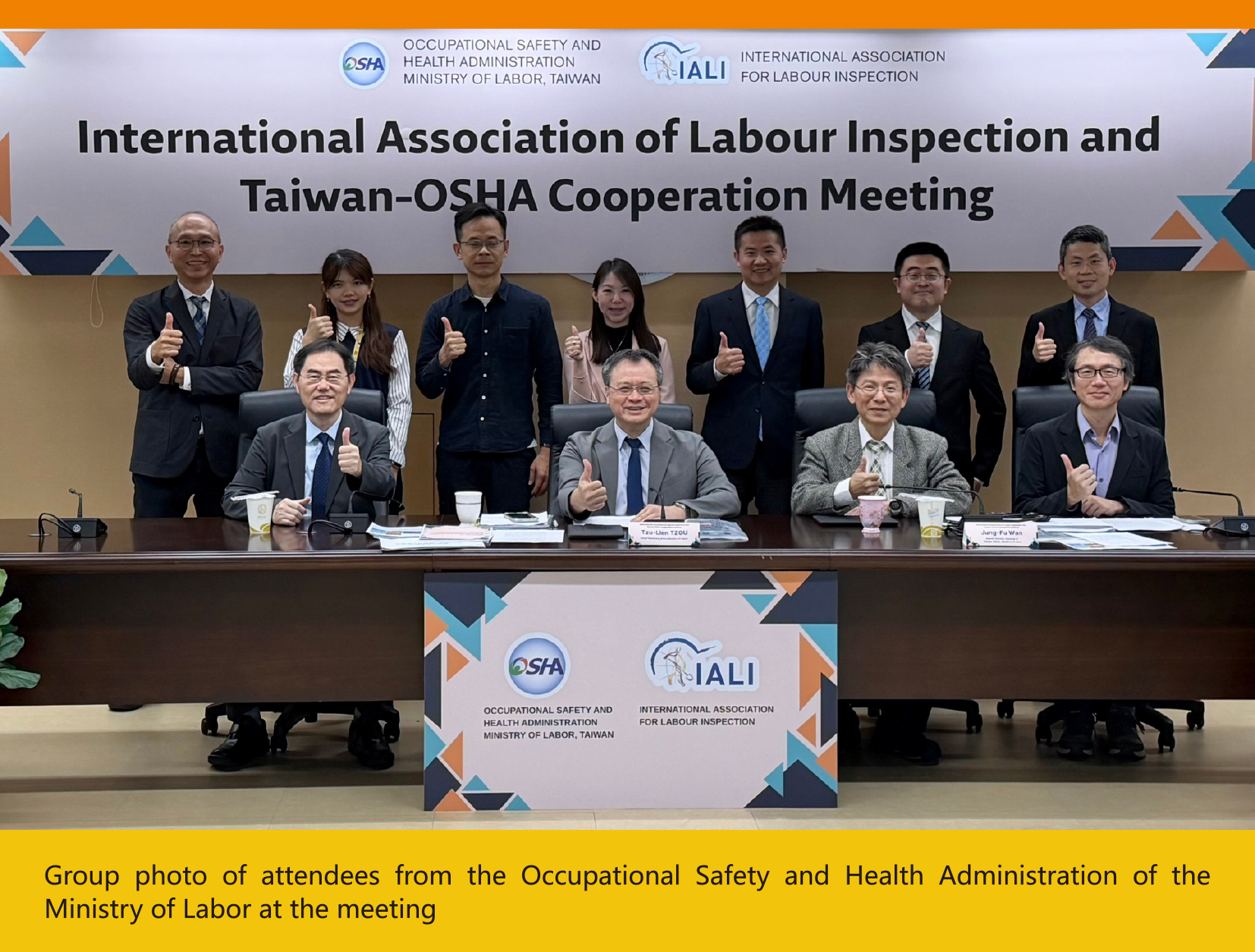
The Occupational Safety and Health Administration (OSHA) of the Ministry of Labor (MOL) and the International Association of Labour Inspection (IALI) held an exchange meeting via video conference on November 14, 2025. The meeting was co‑chaired by Chief Secretary Tzou Tzu-Lien of the MOL and Vice President and Secretary‑General Ana Ercoreca De La Cruz of IALI. Vice President Pal Hilmar Lund of Norway, Vice President Bernhard Raebel of Germany, Technical Advisor Martyn Campbell of Australia, and Deputy Director‑General Wan Jung-Fu of Taiwan‑OSHA participated, along with inspectors from Taiwan's three regional Occupational Safety and Health Centers. Participants engaged in practical exchanges on labor inspection practices and discussed future cooperation.
The focus of the conference was "Workplace Psychosocial Risks, Bullying, and Mental Health from the Perspective of Labor Inspection" and "Risk‑Oriented Inspection Strategies of Labor Inspection Agencies." Taiwan‑OSHA's presentations covered "Taiwan's Workplace Violence and Bullying Prevention Policies, Promotion, and Mental Health" and "Using AI Technology to Support the Implementation of Labor Inspection Strategies," explaining the key points and supporting measures of the newly added chapter on workplace bullying prevention in the Occupational Safety and Health Act, as well as how high‑risk workplaces can be identified through system integration and intelligent data analysis. Meanwhile, IALI shared insights on "Workplace Psychosocial Safety and Mental Health under ILO Convention No. 190: Lessons from Australia" and "Risk‑Oriented Inspection Strategies of Norwegian Labor Inspection Agencies," outlining how to identify mental health hazard factors and build a systematic knowledge base to support risk‑based management.
In addition to sharing strategies for graded management of labor inspections and emerging psychosocial risks, the conference also discussed proposed cooperation with IALI in 2026, including organizing a technical conference on accident‑prevention technologies and arranging overseas training opportunities for Taiwanese inspectors. The exchange was highly productive, and Taiwan‑OSHA will continue to maintain close collaboration with IALI to jointly enhance labor inspection knowledge, strategies, technologies, and tools, and to comprehensively protect the labor rights of workers.
Keywords: International Association of Labour Inspection, Workplace Bullying Prevention, Labour Inspection Strategies
- Source:Department of General Planning
- Publication Date:2026-02-24
- Count Views:
File
- Taiwan Labor E-Newsletter No85 pdf