


NO.88



- Last updated:2026-08-24
- Clicks on the following title, but browses this article fast
- Policies & Regulations Ministry of Labor Implements New Workplace Bullying Prevention Regulations under Occupational Safety and Health Act; Issues Subsidiary Laws and Supporting Measures to Assist Enterprises in Achieving Legal Compliance and Creating Healthy and Friendly Workplace The Ministry of Labor Expands Job Accommodation Services to Further Support the Employment of Persons with Disabilities Protecting Employment for the Elderly! Employers May Not Force Retirement on Workers Aged 65 or Above Due to Their Age
- News Outlook Ministry of Labor Organizes Side Event at International Labour Conference for the First Time, Creating a New Path for International Participation Employers and Employees Signing Minimum Service Period Agreements Must Comply with Article 15-1 of the Labor Standards Act Occupational Accident Subsidies Protect Uninsured Workers, Ensuring Appropriate Coverage With No Gaps!
Ministry of Labor Implements New Workplace Bullying Prevention Regulations under Occupational Safety and Health Act; Issues Subsidiary Laws and Supporting Measures to Assist Enterprises in Achieving Legal Compliance and Creating Healthy and Friendly Workplace

In line with the new prevention of workplace bullying regulations under the Occupational Safety and Health Act (OSHA) taking effect on July 1, 2026, the Ministry of Labor (MOL) has announced the Regulations for Workplace Bullying Prevention Measures and the Regulations Governing the Handling of Complaints of Workplace Bullying Involving the Highest-Ranking Official by Local Competent Authorities. These stipulate the principles for determining workplace bullying, the preventive measures employers should adopt, and the mechanism for local competent authorities to handle complaints and investigations when the highest-ranking official is involved in workplace bullying.
The MOL's Regulations for Workplace Bullying Prevention Measures serve as an important basis for implementing the new regulations. They clearly define the principles for identifying workplace bullying, as well as the procedures for complaint acceptance, mediation, investigation, and requests for review, providing clear standards for industry establishments to follow. Regardless of the size of the industry establishment, employers must initiate the prevention mechanism in accordance with the law upon becoming aware of or receiving a complaint of workplace bullying; the larger the industry establishment, the more complete its prevention and control system and procedures should be established in accordance with the law.
Furthermore, for cases where the accused is the highest-ranking official of an industry establishment, the MOL has concurrently issued the Regulations Governing the Handling of Complaints of Workplace Bullying Involving the Highest-Ranking Official by Local Competent Authorities. This establishes a mechanism for local competent authorities to handle complaints and investigations, avoiding potential conflicts of interest or procedural imbalances that may arise from internal investigations, thereby enhancing the objectivity, fairness, and public trust in case handling.
To assist establishments, especially small and medium-sized enterprises (SMEs), in transitioning smoothly to the new regulations, the MOL is simultaneously implementing the following supporting measures:
I. A "Guide to Workplace Bullying Prevention Measures" has been published for reference by industry establishments.
II. Conducted numerous training sessions through forums and seminars, and produced digital learning materials to provide relevant online learning resources and expand the delivery of education and training.
III. Established a database of professional workplace bullying investigators to assist industry establishments in selecting external professionals to participate in case investigations.
IV. Established a workplace bullying reporting system.
V. Subsidies are provided for SMEs to cover the costs of hiring external professional investigators, reducing the cost of implementing the system and helping establishments comply with legal requirements.
VI. Established a dedicated workplace bullying prevention section, which provides resources such as FAQs, training materials, and guides; collaborated with local competent authorities, labor inspection agencies, and the Center for Occupational Accident Prevention and Rehabilitation to assist enterprises in establishing comprehensive prevention systems.
The MOL recommends that employers incorporate workplace psychosocial risks and employee communication and interaction issues into corporate governance and risk management mechanisms. This involves establishing prevention policies and institutionalized management mechanisms at the source, and shaping a respectful, trusting, safe, healthy, and friendly workplace culture through the commitment of senior executives and cross-departmental cooperation, thereby enhancing employee loyalty and overall corporate competitiveness.
Keywords: Workplace Bullying Prevention, Employer Responsibility, Highest-Ranking Official
The Ministry of Labor Expands Job Accommodation Services to Further Support the Employment of Persons with Disabilities
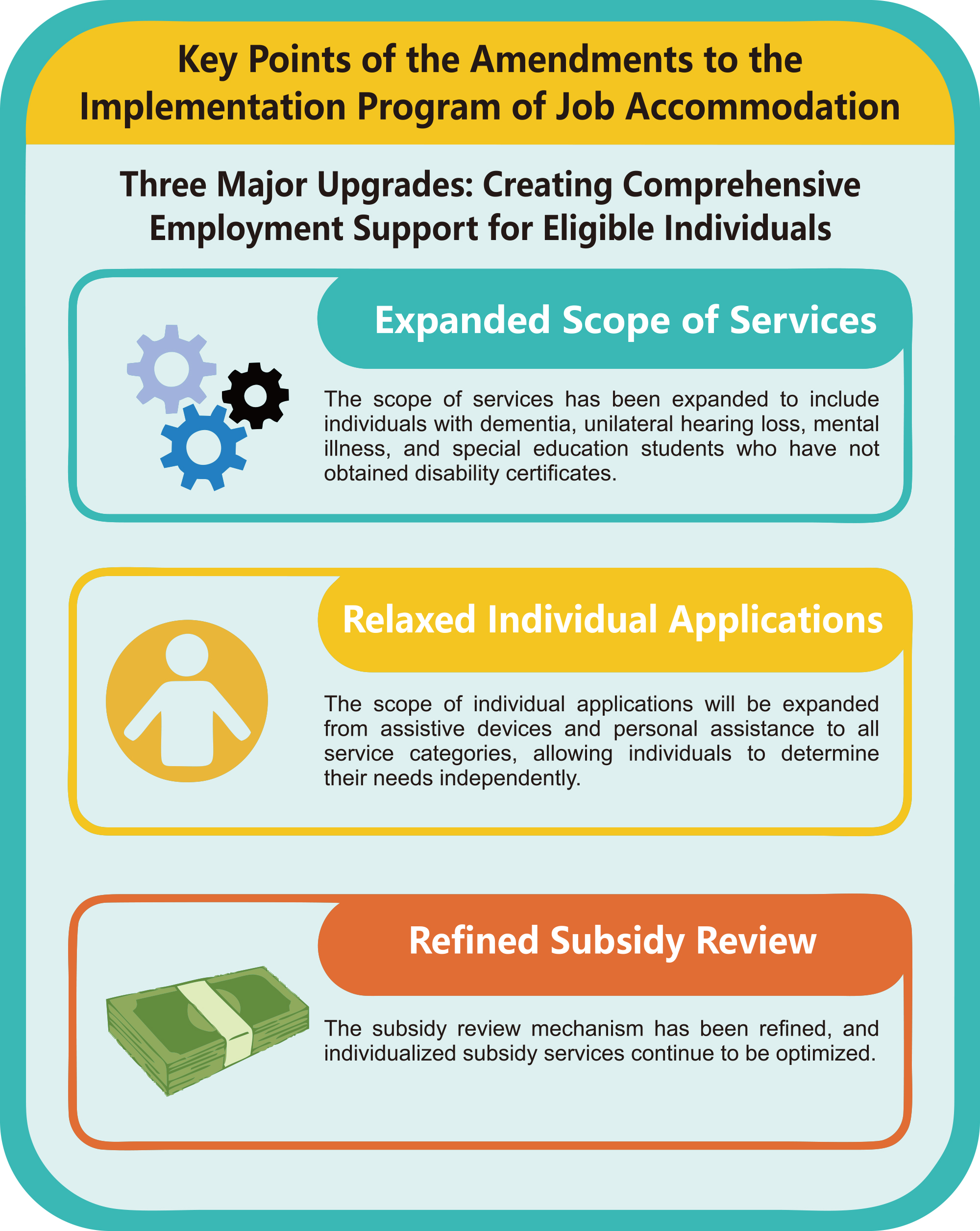
To implement the spirit of reasonable accommodation in the Convention on the Rights of Persons with Disabilities (CRPD), the Ministry of Labor (MOL) announced amendments to the Implementation Program of Job Accommodation on June 2, 2026, in which it provides comprehensive support for persons with disabilities through more flexible service mechanisms.
A highlight of this amendment is the upgrading of service measures. For four groups previously not eligible for disability certificates—those with dementia, unilateral hearing loss, mental illness, and special education students—the scope of services has been expanded to match that of persons with disabilities. They can now receive support in various aspects, including recruitment assessment, support during initial employment, personal assistance, vocational training, and home-based employment.
Additionally, the scope of individual applications has been relaxed. In the past, persons with disabilities could only apply for assistive devices and personal assistance. Now, workers can determine their needs and apply for various services independently, no longer limited to applications submitted by employers. Furthermore, the subsidy review mechanism has been refined. The subsidy amount is based on the balance after deducting any social welfare subsidies already received; to enhance individualized services, a comprehensive review is conducted based on the degree of disability, work relevance, urgency of needs, and workplace utilization rate.
In practice, through Job Accommodation, persons with disabilities can significantly improve their work autonomy after receiving services, thereby enhancing their sense of workplace safety. For example, after receiving subsidies for high-end noise-canceling hearing aids paired with wireless frequency modulation systems, engineers with severe hearing impairments can better understand their supervisors' instructions. After receiving subsidies for electric height-adjustable desks and pressure-relief cushions, individuals with lower limb disabilities can extend their non-interrupted working time from 30 minutes to 2 hours. After receiving tablet-based visual workflow assistance, assembly personnel with intellectual disabilities can work independently with an error rate approaching zero, and the company's evaluation has also improved.
The MOL stated that this revision is a concrete commitment by the government to the employment rights of persons with disabilities and that it will continue to assist workers with disabilities in overcoming limitations and maintaining stable employment. Those who wish to apply can submit a written application to public employment service agencies or local governments, or apply online through the Workforce Development Agency's Job Redesign official website. They can also call the toll-free customer service hotline 0800-777-888 for inquiries.
Keywords: Job Accommodation, Employment of Persons with Disabilities, Reasonable Accommodation
Protecting Employment for the Elderly! Employers May Not Force Retirement on Workers Aged 65 or Above Due to Their Age

To ensure substantive protection of the employment rights of older persons, if an employer hires a worker who is already 65 years old or above, the employer may not invoke Article 54, Paragraph 1, Subparagraph 1 of the Labor Standards Act during the contract period to force the worker to retire on the grounds of having reached the age of 65.
The Ministry of Labor (MOL) explained that the purpose of Article 54, Paragraph 1, Subparagraph 1 of the Labor Standards Act is to protect the employment rights of workers by ensuring that employers cannot arbitrarily request their retirement before they reach the age of 65 if they began employment before the age of 65. However, if the employer is already aware that the worker is over 65 years old at the time of employment and still decides to hire them, it means that both parties have reached a contractual agreement with full knowledge of the worker's age. This situation is different from the scenario regulated by Article 54, Paragraph 1, Subparagraph 1 of the Labor Standards Act, which refers to having reached the age of 65 during continuous employment. Accordingly, the mandatory retirement provision does not apply in this case.
For workers who are already 65 years old or above at the time of employment, if the employer wishes to terminate the labor contract, they must refer back to the provisions for contract termination in the Labor Standards Act. In other words, to avoid violating the law, they should consider the specific circumstances of each case and confirm whether the conditions stipulated in Articles 11, 12, or the proviso of Article 13 of the Act apply.
Furthermore, to support employers in actively utilizing the middle-aged, senior, and elderly workforce and encourage workers to remain in the labor market, the MOL has implemented employment subsidies and subsidies for the continued employment of elderly workers. These subsidies encourage enterprises to actively hire and retain older workers, with a maximum subsidy per person of NT$180,000 for hiring and NT$258,000 for retaining older workers. The Ministry also offers job redesign services to help remove employment barriers, with a maximum subsidy of NT$100,000 per person. Free vocational training is provided to help improve professional skills, and employers are also subsidized for engaging retirees to serve as in-house lecturers or provide practical guidance, thereby promoting intergenerational cooperation and experience sharing within industry establishments. The maximum subsidy is NT$500,000. It is hoped that through the implementation of these measures, more industry establishments will come to understand the strengths and advantages of middle-aged, senior, and elderly workers.
Keywords: Labor Standards Act, Mandatory Retirement, Employment of the Elderly
Ministry of Labor Organizes Side Event at International Labour Conference for the First Time, Creating a New Path for International Participation
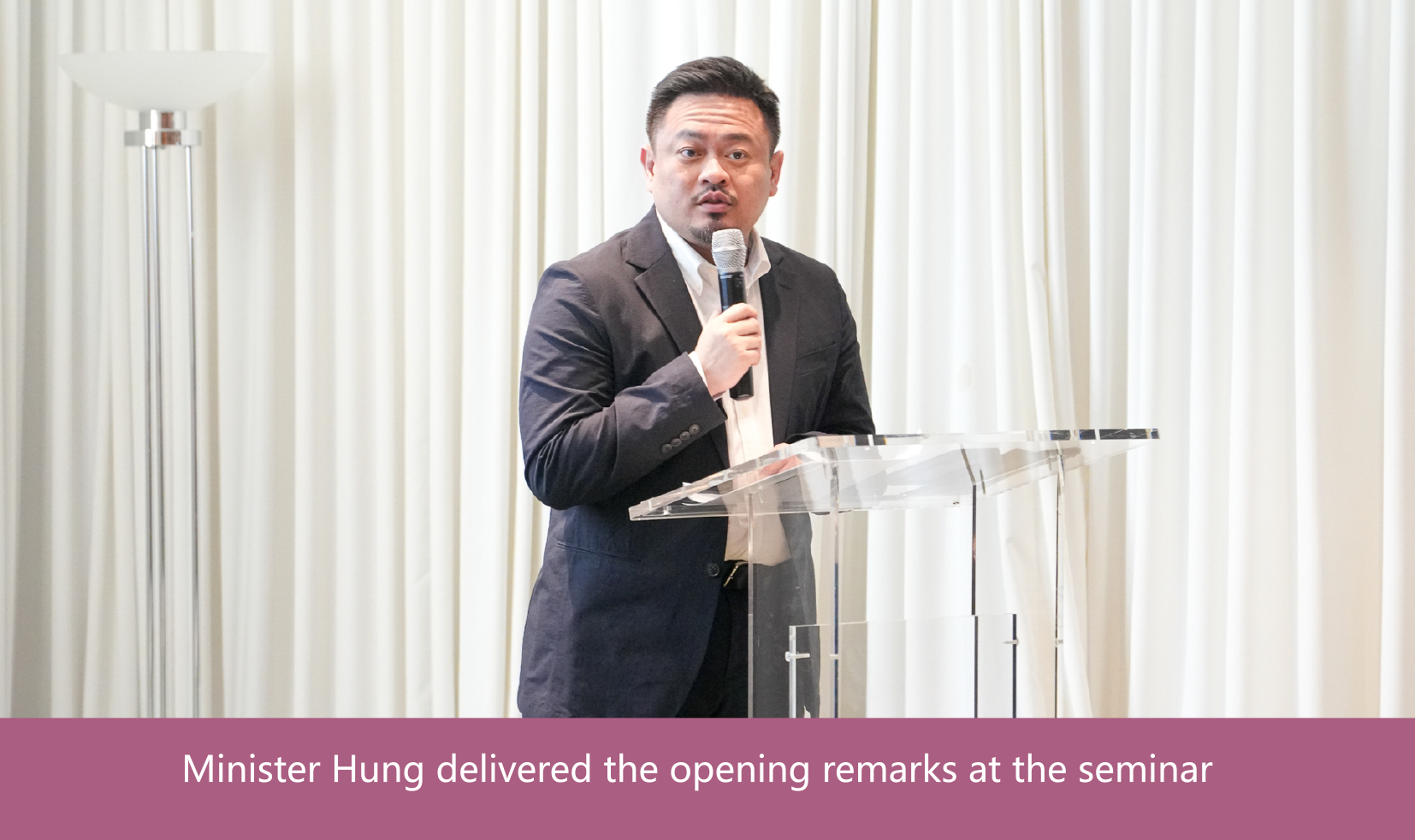
Minister of Labor Hung Sun-Han led a delegation to Geneva to attend the Dignity at Work International Seminar co-organized with the Chinese Federation of Labor (CFL) on June 11, 2026, local time. This is the first time the Ministry of Labor (MOL) has organized a side event during the International Labour Conference (ILC). The MOL invited former Deputy Director Anna Biondi of the Bureau for Workers' Activities (ACTRAV) of the International Labour Organization (ILO), former Deputy General Secretary Mamadou Diallo of the International Trade Union Confederation (ITUC), representatives of national trade unions from countries such as the Philippines and Singapore, and government representatives from countries such as Eswatini, Haiti, and Belize, with a total of about 40 participants. This event set a milestone in the MOL's substantive participation in ILO affairs.
The seminar first exchanged views on the topic "Platform Economy: Innovation in Employment Patterns and Dignity at Work." The MOL explained Taiwan's approach to legislation protecting platform workers. Deputy Director Frederick Ho of the International and Strategic Partnerships Department of the Singapore National Trades Union Congress (NTUC), Deputy Secretary General Joanne Cesario of the May First Movement (KMU) in the Philippines, and former Deputy Director Anna Biondi of the ILO Bureau for Workers' Activities shared diverse perspectives from Taiwan, Singapore, the Philippines, and international organizations, including Singapore's experience with tripartite dialogue among labor, management, and the government, as well as the diversity of platform economy issues in the Philippines.
On the second topic, "Responding to Artificial Intelligence: The Future and Challenges of Labor Policy," the MOL explained the labor issues and policies involved with AI in Taiwan. Chang Wei-Hao, Vice President of CFL, and youth representative Tu Chun-Ying respectively shared international organizations' perspectives and youth perspectives on AI. Finally, Mamadou Diallo, former Deputy General Secretary of ITUC, discussed AI issues from a macro perspective, using as examples the infrastructure and digital gaps in Africa.
In the future, the MOL will continue to collaborate closely with unions and international partners to actively promote exchanges on international labor affairs. The Ministry aims to share Taiwan's experiences in advancing dignity at work, safeguarding workers' rights and interests, and addressing emerging labor issues with the international community. Together with other countries, the Ministry will tackle the opportunities and challenges arising from the transformation of the labor market.
Keywords: International Labour Conference, International Labour Organization, Dignity at Work
Employers and Employees Signing Minimum Service Period Agreements Must Comply with Article 15-1 of the Labor Standards Act
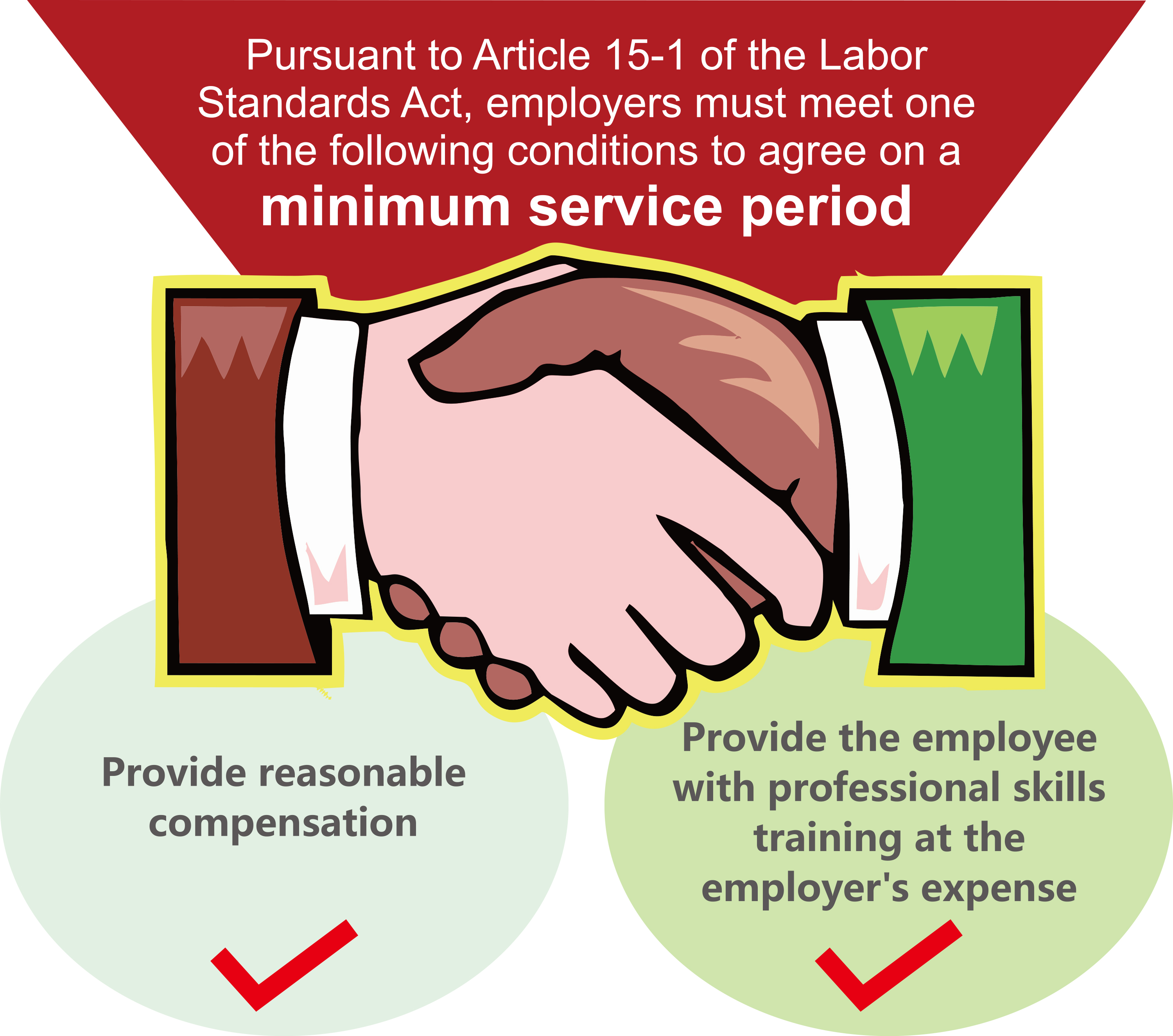
Article 15-1 of the Labor Standards Act stipulates that an employer may only make a minimum service period agreement with an employee if the employer either provides the employee with professional skills training at the employer's expense or provides the employee with reasonable compensation. In addition, the agreement shall not exceed a reasonable range; otherwise, it shall be null and void. In practice, employers often combine minimum service period agreements with penalty clauses, requiring employees to remain with the industry establishment for a specified period and refrain from changing jobs. If they leave before the agreed period expires, they may be required to pay substantial penalties for breach of contract or indemnity. Alternatively, employers may offer retention bonuses or signing bonuses as consideration for such agreements, giving rise to disputes over excessive penalties or the scope of reimbursement.
To reiterate that minimum service period agreements are related to employees' freedom of occupational choice and that employers may not restrict them with unreasonable terms, the Ministry of Labor (MOL) has issued a circular reiterating the provisions of Article 15-1 of the Labor Standards Act and reminding employers to pay attention to the following:
I. When an employer and an employee agree on a minimum service period, they shall comply with the provisions of Article 15-1 of the Labor Standards Act; the minimum service period must be necessary and reasonable.
II. If the expenses are incurred from routine education and training, general on-the-job training, familiarization training for new employees, or statutory training required by law, the employer shall not use them as a basis for agreeing on a minimum service period with the employee, nor shall they be used as a basis for claiming penalties for breach of contract or reimbursement of training expenses.
III. If an employer uses retention bonuses, signing bonuses, or other prepaid benefits as reasonable compensation for a minimum service period agreement, the employer shall clearly inform the employee thereof. If the employee leaves before the agreed period expires and the employer requires reimbursement, the amount to be reimbursed shall be calculated proportionally according to the unfulfilled portion of the agreed service period, and the employer shall not require reimbursement of the full amount.
The MOL calls on employers to carefully evaluate the necessity and reasonableness of clauses related to minimum service periods when making such agreements with employees, and to avoid restricting employees' freedom of employment with improper agreements. If disputes arise between employers and employees over matters such as minimum service period agreements, penalties for breach of contract, or the reimbursement of retention bonuses, they may submit concrete evidence to the local labor administrative authority to apply for assistance in dispute resolution.
Keywords: Minimum Service Period, Reasonable Compensation, Proportional Reimbursement
Occupational Accident Subsidies Protect Uninsured Workers, Ensuring Appropriate Coverage With No Gaps!

To support workers affected by occupational accidents and their families in their post-accident lives, the Labor Occupational Accident Insurance and Protection Act (hereinafter the Occupational Accident Insurance Act) provides the occupational accident permanent disability subsidy, death subsidy, and permanent disability care subsidy for uninsured workers who are not subject to compulsory enrollment and who suffer moderate or more severe disability or death due to an occupational injury, thereby helping meet basic living needs after the accident.
The Ministry of Labor (MOL) stated that since the Occupational Accident Insurance Act took effect, it has established a comprehensive occupational accident protection mechanism. In addition to persons enrolled in accordance with the law being entitled to insurance benefits, workers who are not subject to compulsory enrollment and are uninsured may apply to the Bureau of Labor Insurance (BLI) for permanent disability subsidy, death subsidy, and permanent disability care subsidy if they suffer moderate or more severe disability or death due to an occupational injury.
The MOL gave an example: after retirement, Mr. Wang returned to his former line of work and took on freelance crane hoisting jobs to cover his living expenses. One day while working, the crane boom accidentally came into contact with an overhead high-voltage power line, causing him to suffer an electric shock. He was rushed to the hospital for emergency treatment. After treatment, Mr. Wang was diagnosed with hypoxic encephalopathy and was assessed as having Disability Severity Level 1: "permanently unable to work and requiring assistance with activities of daily living." Mr. Wang's family consulted the BLI about the benefits for which he might be eligible and found that Mr. Wang had not enrolled in labor occupational accident insurance and therefore could not claim occupational accident insurance benefits. The BLI promptly reminded the family that Mr. Wang could still apply for the occupational accident permanent disability subsidy and permanent disability care subsidy for uninsured workers in accordance with Article 81 of the Occupational Accident Insurance Act, and could still receive protection. With the assistance of the BLI, Mr. Wang successfully received a permanent disability subsidy of over NT$1.76 million, as well as a monthly permanent disability care subsidy of NT$13,083 for a subsidy period of up to three years, helping relieve his urgent financial needs.
The MOL added that to respond to diverse forms of work, the Occupational Accident Insurance Act provides compulsory, voluntary, and special enrollment channels. Therefore, uninsured workers, such as workers briefly or temporarily employed by individual employers and persons actually engaged in labor, are encouraged to enroll in occupational accident insurance through the special enrollment system. Get insured. Get fully protected. For more information on occupational accident subsidies for uninsured workers, please visit the BLI's official website: https://www.bli.gov.tw/en/0016010.html.
Keywords: Occupational Accidents Involving Uninsured Workers, Occupational Accident Permanent Disability Subsidy for Uninsured Workers, Occupational Accident Death Subsidy for Uninsured Workers
- Source:Department of General Planning
- Publication Date:2026-08-31
- Count Views:
File
- Taiwan Labor E-Newsletter No88 pdf